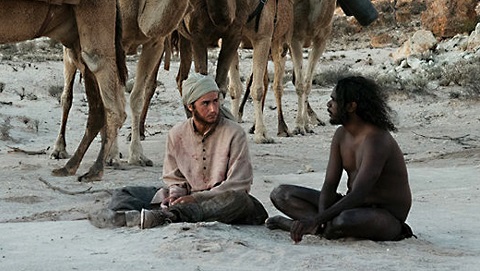
Australia in the 1800s, and in the Outback the British Empire have imported camels to transport both troops and supplies across the vast deserts. The Europeans having little to no experience of training and handling these animals, they have also imported Middle Eastern and Indian "cameleers" from those regions of the Empire to take care of the beasts, often whether these men wanted to or not. One such individual is Hanif (Ahmed Malek) who has been taking camels to and from various destinations in the hope he can raise enough funds to buy his ticket back home, but this is proving difficult - and when fate intervenes, illegal.
Fate being one of his teammates, a Sikh named Jundah (Kaushik Das), getting murdered in the first ten minutes for having the audacity to talk back to a white man, who promptly fetches a gun and kills him, despite the fact Jundah was friendly, helpful and trying to defuse a situation that could have seen Hanif killed himself. The Aboriginal, Woorak (Baykali Gananmbarr), travelling with them then murders the killer in turn in revenge, which puts them in a tricky position, but not half as tricky as Hanif will be in after they stumble on the site of a massacre and he half-willingly opts to help out the sole surviving gold prospector calling himself Mal (David Wenham).
Mal has the gold they were fighting over, you see, but there's a problem if he wants to keep it; actually, there are two - he has a gunshot wound, and the bars have the mark of the British Crown on them, meaning anyone trying to trade them will be immediately exposed as having possession of stolen property. So what to do? Assuming he survives, Mal has a plan, simply get Hanif to help him cross the Outback to a furnace he knows of, where the precious metal can be melted down and made into new bars, this time without the mark. Yet as we have witnessed, there is nothing simple about any life out there, especially if you have the British Army hunting you down.
With that established, we could appreciate the debut feature of director Roderick MacKay, which like a lot of Australian films of the twenty-first century, entertained a definite streak of liberalist self-flagellation, particularly if it had been directed by a whitefella (or female equivalent). This reckoning with the past of the modern continent which had been born in pain and bloodshed was a common thread running through the nation's cinema, though at this point in time it was, as noted, the whites who were making these, which though generating some controversy was better than them not being made at all. MacKay for one was conscious to evoke the sunbleached Westerns of both Hollywood and Europe to appeal to a wider demographic and ground his concerns in the reliabilities of genre rather than be mired in social conscience.
That conscience was assuredly there, but The Furnace was careful to mix it in with a brutality of life as it was lived in Australia in the nineteenth century to add an edge to what could have been a relentlessly downbeat lament for the trampling of both cultures and individuals in the Imperial spread. MacKay was blessed with a dedicated cast, Malek making his first English language movie and proving a sympathetic performer, well-conveying the innocence of Hanif which despite it all he never quite leaves behind since we had to divine some notes of hope in what could have been a punishing hellscape. Contributing was Hanif and Mal were chased by troops led by Jay Ryan, serving up grit and borderline psychosis as an example of what contempt and too much power over people can do to a mind. Though women barely featured, the men were both of a type you would expect to see in one of the Aussie Westerns and slightly off-kilter as the gold obsession chips away at their egos. Love of money is the root of all evil, as the old saying goes, neatly and forcefully related here. Music by Mark Bradshaw.
[Signature Entertainment present The Furnace on Digital Platforms 25th January 2021.]