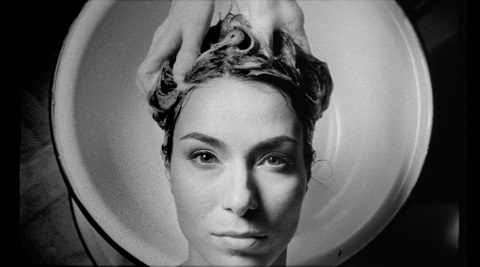
Log onto this website and you will see something that may have an unusual effect on you, something pleasurable but not quite explicable, a feeling you get all over your body if you are susceptible to it. This visitor sits at her laptop and takes in the sights and sounds, in a voyeuristic way perhaps, but also in a very personal way judging by the response as the woman on the screen has her hair washed as she whispers various messages to her. What can it all mean?
Ah, but it's not a meaning you're seeking in your average ASMR video, it's that sensation of being enveloped in a warm, fuzzy duvet of invisible touch, and this feeling has become an internet sensation among those who can call it up apparently at will. Does it reach back to childhood? Does the memory of feeling safe as the vacuum cleaner droned, or the newspaper was read by a parent, turning the pages quietly but detectably, provide a primal comfort?
Even seeing and hearing these in a television broadcast could do the trick. British viewers of a certain age may remember children's programme Play School, where the presenters would talk gently and sometimes make a hat or a boat from a sheet of newspaper, the sound of the paper being folded irresistibly pleasing. Current "quiet time" programmes for kids may breed a new generation of those open to these emotions, if you can term them that.
But the short's director, Peter Strickland, mixed up his ASMR images and sounds (hair being washed, whispered Hungarian, paper softly rustled) with other images of a rehearsal for a violent dance performance between a naked man and woman, its stark monochrome seemingly at odds with the soothing qualities of the other visuals. Was he aiming to disturb, as his features often did? Actually, his previous feature In Fabric had become championed by the ASMR "community" (for want of a better word) for exemplifying the effects of their favoured experiences, despite ostensibly being a horror movie.
Put like this, you can ponder whether Strickland believed it all was healthy or not, or at least the height of self-indulgence. But was it truly voyeuristic if the other person in the video, assuming they're not in the room with you, was complicit and genuinely wished to have this tranquil (not to say tranquilising) effect on you? Was it not more a form of co-operation? The director fully admitted he could experience this phenomenon himself, so was he gaining pleasure too, in eliciting the perception in his audience? Was this not, in fact, trying to instigate some mass warm and fuzzy sensation orgy, only without the sexual aspect? Doubtless there were abundant scientific papers dedicated to just this study, but in the meantime, you could use this as a test of your receptivity.