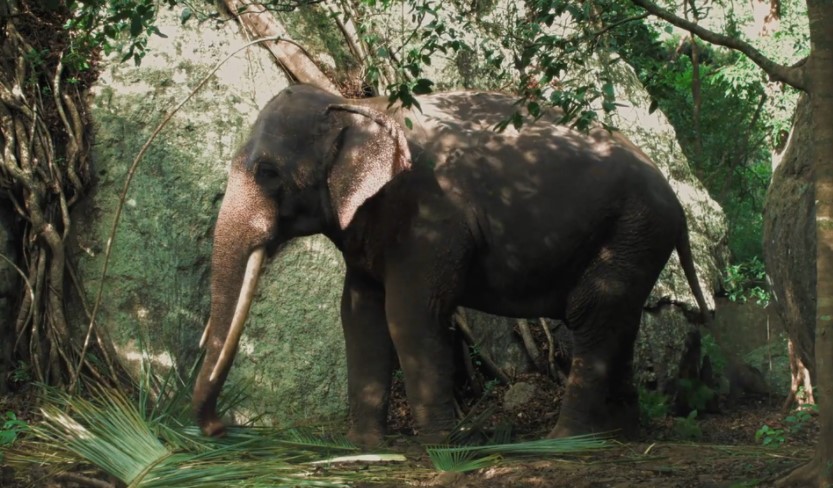
Nga is an elephant nearing the conclusion of its existence in Sri Lanka, and it lives out in the jungle with its mahout, or human keeper and guardian, who attends to its every need. But there tells a legend of a place the elephants go to when they are aware they are going to die, a elephant's graveyard if you like, and as the last of its kind Nga's journey there will be significant, especially as a massive earthquake has rocked the land, with reports of millions of people dead, that is the worst natural disaster in decades. But others are aware of the elderly beast and wish to track it on its final travel, aware that should they find the mythical graveyard of its kind, they will be able to help themselves to a fortune in ivory...
Director Carlos Casas made his career with nature documentaries, but Cemetery was something a little different; on the surface it appeared to be another in the same vein, yet this was more of an art piece, something to generate meditation in the viewer rather than a traditional adventure tale, which was curious as according to him he was inspired by the earlier jungle movies of the nineteen-twenties and thirties. That included Tarzan films as well as explorer excursions, both in fiction and factual (or semi-factual) form, and at the end credits everyone from Rudyard Kipling to Johnny Weissmuller was thanked, more of a heartfelt dedication than anything those men would actually clap eyes upon, of course, but they were interesting references.
Especially as at the point Cemetery was released, those earlier, more colonial views of Africa and Asia had grown deeply unfashionable, rejected as racist even if there was some insight to be gained from their takes. Was this an attempt to reclaim what was by now a neglected genre? It was a brave attempt if it was, particularly as it was an art film to its bones and barely an adventure at all, split into four parts the third of which played out in almost total darkness, perversely difficult to watch because there was hardly anything to see. For a start, this was not related from the outsiders' or settlers' perspective, it was assuredly from the eyes of the locals, and more than that, from the eyes of Nga the elephant, who is apparently some kind of celebrity animal in Sri Lanka, therefore those shots of him contemplating the world or being scrubbed in a river would hold novelty.
They happened in part one, and depicted a kind of idyll in the jungle (despite the radio news about the earthquake) that Tarzan would recognise as his perfect day, in harmony with nature all around (yeah, Tarzan was African, but one jungle looks much like another to the untrained eye). However, come part two and a sinister element was introduced as the armed poachers (of the kind the apeman's movies would regularly pit him against) try to follow the elephant through the undergrowth, tracking it like experts putting their skills to bad use, though the further they venture into the wilderness, the more they begin to drop away thanks to some weird sorcery. Be that from the jungle itself, or the elephant's inherent powers (a psychic Jumbo?), is not clear, but after that the film proceeds with Nga's view and finally some beautiful landscapes at dawn, though it's debatable whether this is supposed to be the legendary graveyard or not. It's a difficult film to spoil with a description since so little happens, and while it could be monotonous to many, it was ultimately a strangely relaxing watch.