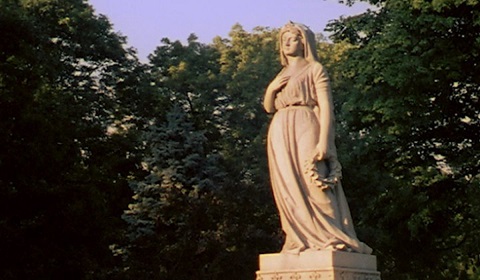
Across the United States, there are grave markers and memorials built to various prominent citizens of the past, and important occasions that took place in various locations. Some of these are better maintained than others, and some of the names have endured further into the future than others as well, depending on how high profile they are over the course of time. But director John Gianvito has undertaken a trek across the nation he calls home to see how they are recognised, and record them...
That trek took about three years, on and off, where he spent a lot of time in graveyards seeking out significant names, resulting in an hour-long film that almost exclusively consisted of images of graves and memorials, interspersed with shots of nature in the areas around these sites, mostly the effects of the wind across the grasses or flowers; sometimes it will rain, too. If that doesn't impress you as very exciting, it was a more meditative piece than one that was supposed to bring history to life in reconstructions.
If anything it was bringing death to life, for there were an awful lot of demises recorded on these markers, many of them violent. Basically, by noting how these people were killed, we would be prompted to ask why, such as early on at the scene of a battle between white settlers and natives which saw the natives defeated - then the word "defeated" is crudely replaced with the word "massacred" by Gianvito on the plaque to let us know how we should be reacting to this unrelenting parade of the dead.
Not everyone has a violent death, but it was enlightening to see that people were still being slaughtered for racial and political motives well into the twentieth century, presumably the only reason this did not continue for another half hour was that recent murders were not memorialised that soon after the fact. The impression was of the United States as a nation built on violence, bigotry and oppression, so that the so-called Land of the Free found that freedom only applied to those with the most money and the best weaponry at their disposal, which included armed men willing to murder for you.
Of course, the Civil War was a major part of the early stages, and there was plenty of representation of slavery before that, sometimes an uprising brutally put down, sometimes an emancipator put to death, or a native who lamented whole races of people were being wiped out (e.g. Red Jacket, whose statue is in Forest Lawn Cemetery). Later, once the internal strife was supposedly over, women's rights and workers' laws were raised as the most important aspects of life going forward - and many advocates of the unions were massacred too, by companies and officials, well into the last century. Then racism created a new brand of orator and activist against prejudice - you guessed it, they were threatened and murdered as well. But Gianvito ended on a sequence of hope, where normal Americans of all backgrounds united to improve the world, seen on George W. Bush-era parades and protests. There is always hope.