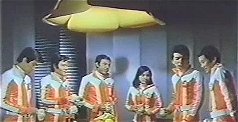
Sometime in the distant future humanoid raiders from the planet Valnastar launch an attack upon the Earth. One of their soldiers, Ken (Tatsuya Azuma), relishes a thrilling laser battle until he happens across a human child stranded on the battlefield along with his terrified mother. A boy coincidentally also named Ken. Taken aback at the thought of killing his namesake, Ken hesitates. When a fellow soldier tries to kill them Ken intervenes and in the scuffle accidentally shoots him dead. Before long he is on the run from his own army across space. Circumstance leads Ken to the Earth ship Bakkus III, commanded by hard-drinking Captain Joe (Jô Shishido) and his stalwart crew - pilot Rocky (Chôei Takahashi), computer expert Tami (Miyuki Tanigawa) and navigator Dan (Tsutomu Yukawa). When Ken’s quick-thinking and super-strength bail Bakkus III out of a close call with Valnastar’s space armada, the initially suspicious Earthlings co-opt him into the crew. Thus giving Ken a shot at redemption as he joins them on a dangerous space mission.
While Japan has its own strong legacy of science fiction literature they have also adapted a handful of notable works by American pulp authors. E.E. ‘Doc’ Smith, often referred to as the father of space opera, had an unauthorized anime adaptation of his Lensman novels. Meanwhile Edmund Hamilton was the recipient of both an animated treatment of his Captain Future novels and this live-action adaptation of his other seminal work, Starwolf. Both made their television debuts in Japan in 1978, just one year after Hamilton’s death. The latter was made by Tsuburaya Productions, the studio founded by legendary special effects wizard Eiji Tsuburaya, creator of among others Japan’s most beloved superhero: Ultraman. In America Starwolf was re-edited into a feature film re-titled Fugitive Alien and released eight years later by repeat offender Sandy Frank, the man who brought Gamera and Battle of the Planets a.k.a. Science Ninja Team Gatchaman to the English speaking audience. Today Fugitive Alien is sadly best known for being mocked on multiple episodes of Mystery Science Theater 3000, the "bad" movie comedy show that continues to influence far too much contemporary attitudes and critical analysis of cult genre cinema. Vintage Japanese sci-fi in particular.
Is Fugitive Alien as bad as the MST3K crowd make it out to be?
Well, certain elements don’t do it any favours. Frank’s campy English dub further ripens the already kitsch, often hysterically melodramatic tone of the source material. Some inconsistent characterization, particularly the titular hero Ken himself (who comes across borderline schizophrenic, at times haunted by war crimes and craving redemption, at others whooping across the screen like a kill-crazy cartoon character), also puts a cramp in the integrity of the plot. As does the odd unfortunate creative choice. Such as the ridiculous curly blonde wigs sported by the Starwolf troopers that give their scenes a certain Ed Wood Jr. vibe.
Yet for all its failings, Starwolf or Fugitive Alien remains notable for being one of the more ambitious Japanese science fiction features of the Seventies. The script deals with some fairly heavy-hitting themes: war, P.T.S.D., loss and redemption even if it does not quite develop them to their full potential. The relationships are also quite well drawn, particularly the uneasy alliance forged between Ken and Captain Joe who, despite losing a wife and daughter to a Valnastar attack, takes the turncoat under his wing. Hamster-cheeked former Sixties matinee idol Jô Shishido is great fun as the amusingly surly, borderline alcoholic yet compassionate and paternal Captain Joe and compensates for series lead Tatsuya Azuma frankly amateurish emoting. Genre veteran Akihiko Hirata also appears in one of his last roles as an Earth force commander. After a promising set-up the second half admittedly devolves into a bit of a mess. The crew are sent on a diplomatic mission to a Middle Eastern-styled planet whose inhabitants treat them like crap for some reason. Ken, hitherto established as tortured and taciturn, inexplicably starts behaving like a drunken frat boy in Cancun, picking fights in random bars until he accidentally kills a soldier. Again! Once is tragic, twice is suspicious.
While the Tsuburaya team’s miniature spaceships and optical effects were obviously made with a television audience in mind they remain eye-catching, inventive and occasionally even ambitious. Certainly up to the high standards set by the seasoned studio. Whiplash editing and offbeat camera angles impart comic book energy to proceedings compensating for an occasionally corny, at times outright bad, script that still exhibits more depth than one would expect. Ken and company returned in another bogus feature: Star Force: Fugitive Alien II (1978).