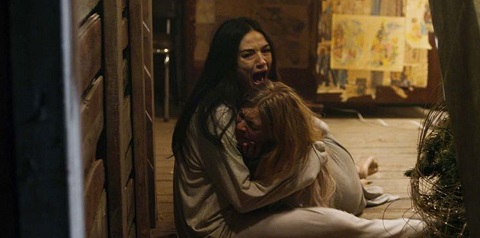
Pauline (Mylene Farmer) is driving her two teenage daughters, Beth (Emilia Jones) and Vera (Taylor Hickson), to their new home, a remote farmhouse in the countryside. As they travel, H.P. Lovecraft fan Beth reads them her latest self-penned horror story which impresses her mother but her sister sits in the back seat and grumbles, though soon has her mind taken off this by the approach of a huge ice cream van which looms up behind them making a lot of noise. As it passes, someone inside waves, and Pauline and Beth wave back, but bad-tempered Vera gives them the finger: with the news story of home invasion killers in the vicinity, is this really the wisest course of action she could have taken? It doesn't do to piss people off...
Director Pascal Laugier will always be a cult director and never a mainstream fixture, that much was apparent as his career progressed, for his raison d'etre was to put his female characters through as much of an ordeal as possible, and in the process make the audience suffer into the unlovely bargain. Obviously not everyone was going to get along with this, and by the point Incident in a Ghostland (or simply Ghostland in some territories) had been released, there were some horror fans beginning to ask some pertinent questions of Laugier's preferred routes to terrorise his audience and actresses alike. Questions like, does this guy have serious issues with women? Because every time he made one of these shockers, he relished the torture meted out to them.
There was one of his trademark twists here, as in his most famous film Martyrs which actually went further in torturing its leading lady than anything here, if you could believe that, which was guessable once you noticed it appeared to have moved into the science fiction genre rather than the horror one, but essentially the plot saw the family of three women terrorised by the two maniacs who had been driving the truck we saw at the beginning, one of whom was a hulking take-off of Sloth from The Goonies, only far more sadistic, and the other a transgender woman (or at least a transvestite) who had no other defining personality trait, other than her extreme violence, something she shared with her victimising pal. With that in mind, you might anticipate a reactionary bent to the way this played out, but there wasn't, so much.
Aside from Beth's worship of Lovecraft which, a couple of years later, would be more problematic since the writer of cosmic awfulness beyond sanity was more identified with cosmic racism beyond sanity, if nothing else demonstrating how quickly the culture moved to damn various popular items and figures in the wider experience. Bizarrely, old Howard showed up as a character too, albeit in the guise of a heavily made-up actor. But that was a distraction for the real main course, which was to put the girls through dreadful times which seemed to follow them to adulthood, as played by Crystal Reed (Beth) and Anastasia Phillips (Vera), the former becoming a famed horror author, the latter a damaged PTSD case living in a padded cell in the farmhouse basement. The production designer certainly earned their salary, as that building was adorned with creepy dolls, ornate mirrors, and a labyrinth of corridors that was enough to sustain the intrigue. After a while, it was just one damn thing after another with not enough variation in the screaming and abuse that some regarded as a critical assessment of attitudes to women, not that there was much evidence for that in the viewing: no fun, but well done.