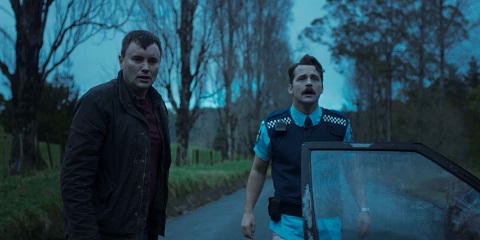
Marbles (Thomas Sainsbury) knows how he would like to spend his time living in New Zealand: getting high as a kite on cannabis. But thanks to his experiments in pursuing that level of consciousness, he happened upon a formula using his late father's medication that enabled him to see ghosts, and he has been using this ability to generate some income as a psychic for hire. Or that's the idea, for while the chemicals do work on him, he is often too soft-hearted to take money from his clients, especially when the ghosts are in a bad way or some uncomfortable revelations about their feelings have been made apparent. But then he gets a special message...
Delivered in person, from a recently murdered policeman, Officer Tagg, played by Hayden J. Weal who not only co-starred in this, but co-wrote it with Sainsbury and directed it into the bargain. You often found that almost home-made quality to the lower budget New Zealander genre efforts, with much multitasking in the cast and crew responsibilities, and the bluntly-titled Dead was no exception. It was a comedic take on the ghost genre, you know the sort of thing, The Frighteners (also a comedy from that part of the world), or The Sixth Sense with laughs - there was even a connection to the popular British sitcom Ghosts, contemporary to this movie.
That was the fact that Tagg spends the whole story not wearing any trousers, just the rest of his uniform, much as Simon Farnaby did in character in the British series, but there were so many supernatural comedies where certain people can see the phantoms and almost everyone else cannot - Whoopi Goldberg in contact with Patrick Swayze in actual Ghost being the most prominent example - that Dead was more in a tradition than a straight rip-off. And "straight" was not a word that applied to it too aptly either, for though it was not publicised as such, probably because it was presented matter-of-factly, this was a gay comedy, as Tagg is of that gender persuasion.
You may think Marbles was too, but he is given heterosexual love interests, two of them, even if the first turns out to be a lesbian. The other is Tagg's sister, Yana (Tomai Ihaia), who has been confined to her home with an ankle tag, but when he persuades Marbles that he needs to help him solve his own murder, she must be recruited too, therefore personal information is revealed in time-honoured tradition to convince her that her sibling genuinely is there in the room in spirit incarnation. In fact, Tagg is not the first person to die at the murderer's hands, as a serial killer appears to be active in the community, targeting gay men, which leads us into a nice little mystery plot that simmers away under the steady stream of daft, irreverent jokes the two authors had dreamed up.
There were other characters too, though not so many that you really should feel as if you can identify the murderer, who in another tradition is someone we have met in the course of the unofficial investigation (Tagg is the only cop we see, and he's deceased). But the explanation for what is really going on was so outlandish and bizarre, while still in keeping with the parameters of the fantastical world Weal and Sainsbury had concocted, that it would be very surprising indeed if you managed to second guess it. There was a satisfyingly self-deprecating sense of humour to this that helped it over a few, er, dead patches, and while the horror element was not laboured, the idea that ghosts start out conscious of their surroundings then degenerate into spectral zombies was a clever one, and something different for both the ghosts and zombies categories that combined the two neatly, since it is Tagg who is threatened. Dead wasn't going to change the world, it was too derivative in many ways, but the approach lifted it to winning status.