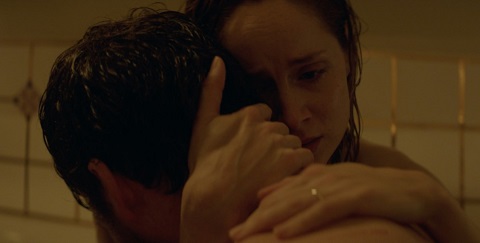
Rose (Sophie Rundle) lives deep in the forest with her husband Sam (Matt Stokoe), all alone, and she spends her time not out enjoying the sights and sounds of the countryside, but permanently indoors where the windows are blocked to prevent any sunlight entering their abode. Sam dotes over her to the extent that he forbids any contact with the outside world, but that is easier said than done when there are curious folks always threatening to impede on their peace. This is why he has set up traps around the cottage: partly to catch rabbits and other wildlife so he can serve them up as meals, and partly as a warning system whenever anyone is in the vicinity and getting too close for comfort - getting your leg caught painfully is perfect for scaring away any... enemies.
Proof some keen use of locations and production value will make up for a lack of budget, Rose: A Love Story was one of those chillers that happened along in the twenty-first century that were labelled "elevated horror" in some quarters, which basically meant they dipped into the techniques and tricks of the horror genre while remaining wedded to the arthouse. Comparisons between this and one of the highest profile efforts in that line, The Witch, were obviously going to be made, but producer and star Stokoe's script was less wary of diving straight into the shock elements, and the blood flowed freely in select places, not least because one of Sam's bizarre practices involves taking a jar of leeches and applying them to his bare legs to harvest his red stuff. But why?
You can guess they're for Rose, who needs special treatment in a manner that almost makes this a tale of a man looking after his ailing wife, in a medical drama kind of way, only the trappings of the snowy forest and the chilly, darkened cottage were more akin to a Grimm's fairy tale - before they rewrote them as more palatable for children. But the script kept its cards close to its chest, and didn't entirely explain everything in the abrupt, violent climax, adding a mood of mystery that director Jennifer Sheridan boosted with her knack of getting the right sense of menace to even the most loving of scenes between the two protagonists. Every shot in this contained a look of ominous potential, as if something really dreadful was going to occur no matter all the precautions Sam was so careful to put in place, which is of course the textbook example of the horror movie structure.
Sam does have some contact with the outside world, yet when he goes to meet that contact something has gone wrong and he has been replaced by a superficially plausible stand-in, not that Sam is convinced, and is forced to take matters into his own hands. At this point we can wonder if he is somehow victimising Rose to keep him all to himself, jealously guarding her against any prying eyes so she can be his and his alone, but the truth is he is justified in trying to keep her solitary, tragically so. Halfway through there is the introduction of a very non-fairy tale character (Olive Gray) who was essentially the equivalent of the kind of person who will walk in on you and demand to know exactly what it is you think you're doing which leaves you flustered and embarrassed even if it was perfectly innocent. But Sam and Rose are not so innocent, or anyway they are concealing a ghastly secret that does not appear to have been any fault of their own, they merely have to live with it until... Well, let's not give the game away, as a more traditional horror plotline is referred to, which is undeniably effective when it falls into place. Maybe a shade constrained, but they made that succeed for them as it suited the heavy atmosphere. Music by Cato Hoeben.