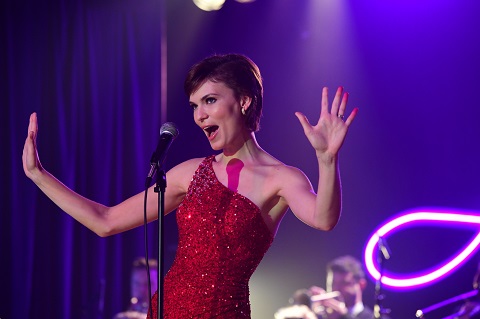
Helen Reddy (Tilda Cobham-Hervey) flew from Australia to the United States with her three-year-old daughter and a return ticket just in case: she had won a competition back home to get her a recording contract, and was determined to succeed in her chosen profession as a singer. But on arrival in New York, at the record company she was told that the prize was not so much a contract as an audition, and she had already performed that when tapes of her had been sent from Australia; not only that, but she had failed the audition. Disheartened, she considered going back defeated, but secured a job as a nightclub performer and struck up a friendship with fellow Aussie Lilian Roxon (Danielle Macdonald), a writer who knew Helen had potential...
I Am Woman became Reddy's best known song, though mainly in North America - in Britain, for example, it was the strange, supernatural tune Angie Baby that was most recognisable, one of her later hits in the nineteen-seventies. But that is too weird to hang a biopic around, and besides, it was vital to convey just how important that feminist anthem had been to women of the seventies where she became famous, the first Australian to win a Grammy. The song reached number one in the charts, and energised the burgeoning women's movement as something they could soundtrack their fight for equality around, not only that but the lyrics were not the words of some meek, demure, second class citizen, but someone who was prepared to stand up for herself and her gender.
Obviously with the seventies being a decade of great social upheaval and reassessing the parameters of the wider community, the anthem was perfect to evoke all that turmoil and success, and we live with the consequences of that in the following century, even if the advances can feel they are being chipped away at by the forces of conservatism (not all of them male). Therefore Reddy's story felt like one worth telling to remind where we had progressed to and what was at stake, but one wonders whether I Am Woman, the film, quite grasped the subject, at least for the first half. That opening hour was very televisual, the swearing aside, with scene after setbound scene shot in that oddly drab technique this era's historical movies tended to utilise to evoke the past, when something a lot more visually pleasing might have been a better choice to keep it engaging.
But then something happens in the second half that finally seems to bring Reddy's issues to life. It doesn't seem like a significant scene, but it brings her biography into sharper focus as a reporter interviews her as the new poster girl for feminism, and her manager husband Jeff Wald (Evan Peters) is brought in to question his masculinity, as if being in a relationship with a strong woman somehow makes him, or anyone, less of a man. Suddenly we get the sense of the injustice of the views of the time which criticised any female trying to assert herself, or even represent herself of feel represented in a positive way, and that mood the times were changing to a more progressive method of doing things in the world is at last energised in the film. Yes, it was rather indebted to the most recent remake of A Star is Born, though not, thankfully, cramming the facts into the box of tragedy too egregiously, and by the end you have a fair, if not terrific, portrait of someone who made a difference in an admirable style: through her music. Airport 1975 fans may be disappointed it doesn't merit a mention, mind you.
[The film is in UK and Irish cinemas and on digital platforms Friday 9th October 2020.]