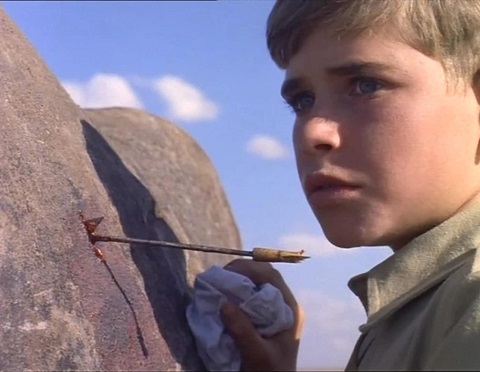
David (David Ellis) lives on a Kenyan wildlife reserve with his uncle (Tom Samuels), who is the warden there, and has built up a confident relationship with the animals, from his pet bush baby to the area's last remaining rhino, who he nicknames Black Beauty. Today, David is in a grumpy mood because his cousin Susan (Susan Millar-Smith) is arriving from England for a holiday in Africa, though actually because her mother is seriously ill and needs an operation. David doesn't think he has anything in common with her, and besides, "she's a girl!", so when he is torn away from the creatures, he is not happy. But there's something upsetting the rhino as well...
An arrow in the side will do that, yes, someone has been trying to hunt Black Beauty! This was a production of The Children's Film Foundation, which took advantage of the facilities available to them in Kenya for writer and director Henry Geddes to conjure up this modest but well-meaning effort, lasting just under an hour. He allowed his camera to take in the vast, flat plains dotted with scrub which might as well have been the Moon for all that most British children would have been familiar with them - this was before popular family television show Daktari appeared on the small screen, though it was not a million miles away in tone and purpose from that item.
Bearing in mind the era this was made, moving out of colonialism, you may be suspicious of the depiction of Africa here, but we didn't get to see that much of it as far as the people went. There were workers who lived with the warden who were friendly and largely non-stereotypically represented, though you could quibble at the cook's apparent pastime of sleeping in a deckchair which allows David to steal a Land Rover and eventually crash it in pursuit of the rhino. The local tribe, however, were aggressive towards the titular beast and dead set on hunting it and killing it, and though they were not really characterised to any great extent, they were plainly the villains. Mind you, none of them ended up pushed in the water at the end, so that was unusual for the C.F.F.
It is up to David to save Black Beauty, and he learns a lesson that girls are not all soppy and ignorable thanks to Susan's resourcefulness after an initial wobble where she has to acclimatise to Africa and doesn't get on with it very well. The warden does threaten to shoot the rhino himself first, it should be marked, explaining that a wounded animal such as that will be a menace to the locals since it makes an already bad-tempered creature only more dangerous, but David talks him round, so there is a happy ending. Not so in real life, where many rhinos were hunted to extinction because of a trade in their horns, a savage business that cared precisely nothing for ecology and preservation of rare wildlife. There was a sense of looking into the past where the future might have been a little more optimistic with The Last Rhino, and it did have some fine footage of Africa in the nineteen-sixties. It was a film recorded without location sound, so you may recognise Maurice Denham's tones stepping into to voice the warden. Music by Edwin Astley.
[This is included as an extra on the BFI's Blu-ray of After the Fox.]