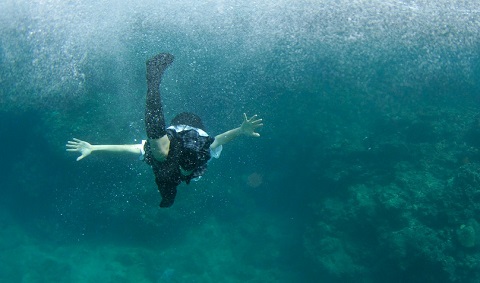
Kaito (Nijiro Murakami) lives on a Japanese island with his single mother, his father, who he remains in contact with, having left some time before. He has trouble thinking of his mother as a woman who may be interested in other men, but something happens one evening that crystallises his feelings in a shocking way when he is out on the beach, after the storm has happened earlier that day, and discovers a naked man's dead body floating near the shore. It has a tattoo on its back that has significance for Kaito, and when his girlfriend Kyoko (Junko Abe) tries to ask him what is wrong, he turns tail and flees into the darkness. The police are called in to investigate this corpse, not sure if there are suspicious circumstances, but what does Kaito know?
Writer and director Naomi Kawase decided to big up herself when Still the Water was released by announcing, guess what everyone, I've made a masterpiece! We'll be the judge of that, said the majority of those who watched it, and while there were some who agreed with her self-assessment, there were more who failed to see what was so great about her achievement here, settling on a description not as a masterpiece, but as yet another indulgent arthouse effort that littered the independent cinemas of the world and tended to pick up awards and that sort of praise, but not so many audiences who embraced her work enthusiastically. Not as enthusiastically as Kawase herself had embraced her work, which had only bred suspicion in those coming to this.
Mind you, if you don't have confidence in your projects, what's the point in making them? British director Bryan Forbes famously proclaimed his own film Whistle Down the Wind as one of the greatest ever made in a poll of filmmakers' opinions, so Kawase was merely following in that boastful tradition. The problem arrived when you had to consider if she was correct in her assessment; she had certainly amassed a small but loyal following of those who responded to her sensitive, at times enigmatic dramas, and if they were happy with her output then who were the naysayers to complain they may not be too critical in their conclusions, or not critical enough? What the main issue here would be was the apparently placid surface of contemplation of life, gender differences, nature and so forth, and the jarring way Kawase interrupted this.
Therefore you would be just settling into a groove of watching Kaito and Kyoko, say, sharing a bike ride down a picturesque seaside road, and five minutes later you were watching a goat being slaughtered for real on camera to make some statement or other about death. Now, there was a dying character in the story, Kyoko's mother who she shares significant conversations with as she gradually slips away, and you would have thought that would be enough to bring out that particular theme, but nope, we had to have authentic animal death too - not to mention the destruction of a centuries old banyan tree that may well make the average nature lover wince. Then there was Kaito's confrontation with his mother in the latter stages that reveals him as an awful prig who only thinks about himself, fair enough, this was part of his journey to coming to terms with himself, but it was not a scene in isolation. What you were left with were a series of attractive visuals broken up by shots of ugliness, and vague instructions to learn something from this experience. Maybe you will, maybe you won't. Music by Hashiken.