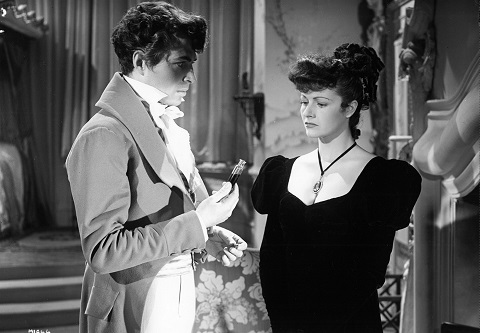
An auction, and soldier Peter Rokeby (Stewart Granger) has turned up to see if he can buy an old possession of an ancestor of his, whereupon he meets an attractive girl in uniform (Phyllis Calvert) who after some discussion and attempted flirting on his part reveals that she is there because some of her ancestors' possessions are up for sale too - and hers would have known his. What neither of then are aware of is what that relationship back in Regency England would have been, actually the girl has inherited her relation's name of Clarissa (also Calvert), who had a fateful meeting when she was at a finishing school back then. Hester Shaw (Margaret Lockwood) was the person she met who she decided to be friends with - she would have been better not knowing her at all.
The Man in Grey holds an interesting position in the history of British film. For a start, it cemented the idea that Brits loved to watch stories featuring their history, be that in adventures or romances or many more categories, so you can trace a line from this massive hit to the likes of Hammer Horror and television serials like Poldark all the way to the present day. Gainsborough was the studio that produced it, which famously had a woman in full corseted and primped get-up simpering and nodding politely at the camera for its logo, but audiences were showing up to see their melodramas so such embodiments of gentle femininity would be defiled, trampled, and altogether badly treated by cads and women of no virtue, all for their entertainment.
Lockwood was often the wicked lady in these, and indeed starred in a following film called The Wicked Lady, this genre making her a huge star for a short amount of time, as the Gainsborough strain of historical romances with their treat 'em mean, keep 'em keen ethos would not prove lasting at the box office in themselves, leaving others to adapt and take up the baton to provide variations that stayed a draw for the domestic crowd. James Mason, too, was in this, as an absolute bounder who marries poor, pure Clarissa merely so she can give him heirs, and here was the role that similarly made him a superstar, nicknamed The Man You Love to Hate. He, of course, wasn't interested in this sort of thing and did them solely for the money and exposure, but nobody said a star had to like the roles that they were particularly adept at.
The Man in Grey was what was commonly termed in the parlance of the day a bodice-ripper, where you were never five minutes away from a heaving bosom or a rakish scoundrel sweeping the owners of the heaving bosoms off their feet. Its attitude to women was, shall we say, complicated, aimed at them in their wartime dejection to offer plenty to take their minds off the conflict for a couple of hours, encouraging its female characters in their own agency in their stories, even to the extent of the bad girls like Hester, but once they go too far it was time to take out the horsewhip and put them in their places. This example also had a young boy slave as an important character, who has often been identified as a white kid in blackface, but he was actually Antony Scott, son of one of the minstrel team of Scott and Whaley.
They were African American entertainers who made it big in Britain (they even had their own film, a first for black stars in Britain), it was just that the child seemed to be slathered in dark makeup because he was not judged black skinned enough. There were also racial insults used on a couple of occasions, though at least slavery was acknowledged, not often the case in ostensibly escapist period drama. But in the main it was the central quartet that we were asked to alternately sympathise with or boo and hiss, and the curious mechanics of having a viewer get on characters' sides by having them suffer as much as possible was very much in evidence here. Granger was the roguish nice guy, Mason the roguish not-so-nice guy who nevertheless administers justice by the finale, and they were inarguably charismatic, while Calvert made more of her good girl role than you might expect, but it was Lockwood as the fairly complex social climber with high malevolence factor who was the big draw, Mason fans aside. Overall, this certainly makes a meal of things, and looks sadistically camp now, but if you can make allowances for the era the stars do have a magnetism about them. Music by Cedric Malleby.
[Network's Blu-ray of this title in The British Film has the trailer, a vintage Mason documentary and an image gallery as extras (beware of spoilers in all three!).]