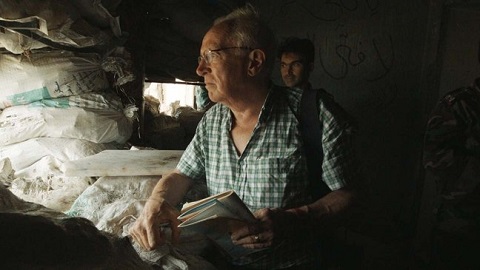
Robert Fisk is a British journalist who has been reporting on war zones for most of his professional life, largely those in the Middle East - he currently lives in Beirut, all the better to get to the heart of the story. He is unconvinced by the validity of impartial reporting, since he remembers his time in Belfast where he discovered British soldiers were executing suspected terrorists both in Northern Ireland and across the border in the South, yet was also present at the Oxford Street IRA bombing where he witnessed the body parts strewn across the ground, and a fireman who had a breakdown as he tried to put out the flames, both of which led him to hold strong views about anyone who would use violence and murder to get their way...
That is what he believes war is about, death and murder rather than winners and losers and noble causes, an opinion he expands upon in Canadian Chinese director Yung Chang's documentary on one of the singular foreign correspondents of his era. Then in his early seventies, Fisk showed no indication of giving up his work, determined to find out the truth of the situation in the face of accusations of supporting terrorists or totalitarian regimes alike, indeed if there's one thing you take away from this, whether you believe he is a moral crusader or sap for delivering propaganda that looked like news reports, it's that if you're bitterly criticised by either or both sides of a conflict, you're either very wrong or very right. What if Fisk is very right?
That was the question posed by this film which as the title suggested, was not going to be clear cut in a Hollywood style in any way, leaving you with perhaps more uncertainties that you would prefer, but satisfied you had been provoked into some new territory of thought. The trouble with that was, of course, that the more the uncertainties preyed on your mind, the less you could be sure of anything you were told in the media: it was touched on, but Fisk was extremely sceptical that the online rumour and conspiracy mill was doing anyone any good. Likewise, he believes that going out in the field and using eyewitness testimony, your own and that you have collected, it absolutely vital in crafting the best journalism you can - don't simply go by what you have heard, with all those prejudices and gossip, find out for yourself as best you can for those who do not have the luxury of being able to do so themselves.
Naturally, this led to some tricky areas. Living in Beirut, Fisk has been accused of anti-Israeli sentiments, and with that, antisemitism, which in his native Britain had become a hot topic thanks to pro-Palestinian elements in politics being judged as scheming against Jews in general and propagating the same old stereotypes and lies that had plagued the debate for centuries. For the record, Fisk was certain the Israelis should have their own state, but that did not excuse the massacres that tragically erupted under their watch, and at their instigation, across the decades since the state was established. Then again, he did not condone Palestinian massacres of Christians either, and was convinced the rhetoric employed in much of the media when atrocities take place was simply used to boost prejudices and obscure truths, and indeed solutions. He did not go as far as saying there was money in war - in Syria, for example, which we see him visiting - but that was clear to see. Somebody profits, and even if we may disagree with Fisk, we should be glad he was obsessed with highlighting sobering facts.