This writer (Mariana Lima) used to be married, and her husband would take her to exotic locations around the world where they could soak up the atmosphere of being in foreign climes. He would take his video camera and record much of what they saw, all the better to preserve it in his memory, but on one holiday it all went horribly wrong. After a day of capturing a selection of rural sights such as forests and lakes, they ventured to the beach where he became entranced with filming a group of native fishermen who were casting their huge net into the ocean before them. As the crows cawed around them, hoping for something to eat, the writer's husband suddenly suffered a heart attack and collapsed: he was dead, and she had no one to spend her time with.
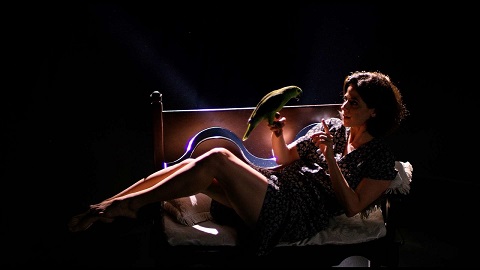
Well, that's not entirely true in veteran Brazilian experimentalist Julio Bressane's late period item of eccentricity which decided to take on his country's relationship and reaction to animals, from the birds of the air to the meat that they consume. For most of the middle section, once the camcorder footage of that fateful vacation was dispensed with, we see Lima sitting at a desk which holds some papers, a jug of water and a plate of uncooked beef, deep in discussion with a lovely green parrot sitting on a perch nearby. To be honest, this conversation is more of a monologue, for though parrots have been known to talk, their discourse skills are lacking, so said bird simply sits there preening and to all intents and purposes oblivious to the writer's observations.
And what observations they were, taking in the erotic appeal of feathers, to the extent that we see her holding the parrot and encouraging it to crawl over her (clothed) body as she rhapsodises about the feel of a good feather on her skin: later we see her stroked by a crow's wing (which may or may not be attached to the bird). If you think that's a singular approach to our feathered friends, wait till you see how she reacts to Daisy the Cow and Ferdinand the Bull, though you had to wait till the last act for things to get truly off the wall (yes, even more off the wall than the parrot business). Bressane was a director keen to show off his erudition, so he has his only performer wax lyrical about classical myths and legends connected to animals, and more specifically bestiality as she avers such sexual perversion was a staple of ancient times.
Now, South America in general has a strong connection to beef farming, that much has been clear for centuries, and Brazil was no different. Yet Bressane went far further, suggesting this reliance on the flesh of animals was a lot more corporeal than his countrymen and women cared to admit, taking it as far as an erotic fixation with meat, such was their all-consuming (literally) obsession with the bovine. Just as you are growing worried she was going to eat the parrot, the plate of meat came into play, as the writer is viewed outside (in black and white for some reason) and pursued by cuts of the beef that slither along the ground and down stairs after her. If this wasn't enough to make carnivores consider vegetarianism, she goes further and winds up having sex with the meat, which disappears up between her legs or covers her body strategically so we don't see any naughty bits as she writhes in ecstasy. This probably goes further than most flesheaters would consider with their evening repast, and before that most bird lovers would have to say interspecies sex wasn't something on their agenda either, but you have to see this as satirical - Bressane couldn't mean it in all sincerity, could he? Music by Guilherme Magalhaes Vaz.