The year is 1925 and in this London lawyers office, young Arthur Kidd (Adrian Rawlins) has been called to his boss's office for a new assignment. It seems a septuagenarian widow has finally passed away after spending much of her life latterly living in an isolated country house on the South Coast, and Arthur has to be sent to attend the funeral and see about her remaining effects. It means leaving his wife and two young children behind for a few days, but this is a good job he has and he wants to keep it, so agrees to the journey. However, there is something he is not aware of, something about that house that someone should have told him...
A Ghost Story for Christmas was a tradition on British television throughout the nineteen-seventies, but that had been broadcast on BBC2. The Woman in Black, however, was shown on ITV, then the most popular channel in the country, and the audience were not expecting what unfolded that Christmas Eve, which left many viewers too scared to go to sleep, or at least sleep easily before the most wonderful time of the year. It had been based on the popular Susan Hill novel, a slender volume that was an attempt to revive the form as made famous by the likes of M.R. James in an era where horror fiction had become synonymous with the excesses of Stephen King and James Herbert.
Hill succeeded admirably and turned her story into a hit play that became a must-see in its day, so by this point a film version seemed like the obvious choice for the next stage. However, it was television that came beckoning, and the scripting duties were given to Nigel Kneale, the no-nonsense author of many a fantastical project who had terrified Britain in the fifties with Quatermass, and gone on to do the same to the seventies with The Stone Tape and his anthology series Beasts. Come the eighties, his biggest contribution to the horror genre had been his dalliance with Hollywood on Halloween III: Season of the Witch, an experience that soured him so badly he took his name off the result.
But Kneale was not done with the eighties, and his work on The Woman in Black represents an interesting example of a writer improving the source material for a different medium. Not improving on the book, that remains a classic, but adapting it for the small screen in such a way that it made the most of the techniques it employed, and was ever aware of the circumstances in the room where it would have been watched. Therefore Kneale appealed to the particular Christmassy frisson of watching a scary story at that time, with the curtains drawn and the fire (or the central heating) on, knowing outside it would be cold and inhospitable, yet rendering the viewers' living rooms and bedrooms the perfect cauldron for giving them an almighty case of the creeps - and one all-time great shock.
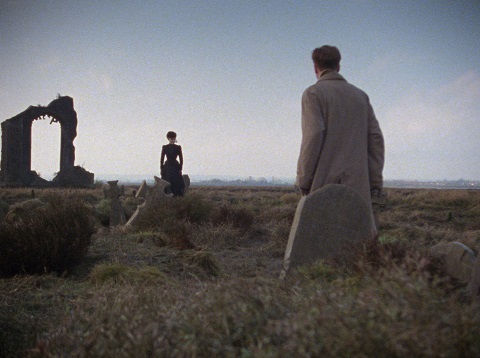
With veteran director Herbert Wise at the helm, a man who had also made a national talking point of I, Claudius a decade before, The Woman in Black sees the hapless Arthur visit this tight knit community and quickly finding he is the only person at the funeral aside from a local dignitary who appears to be there out of some duty or other. But is there someone else present? Arthur keeps catching sight of a woman in a black dress who stands staring at him, balefully for no reason he can perceive, and that was part of the plot's power, for our hero just does not deserve to be victimised in this fashion, he has done nothing wrong, if anything he goes to the empty house out of the kindness of his heart. He nevertheless pays a terrible price for it, arguably too high to be dramatically satisfying, but that uncalled for brutality in the spirit he attracts is, as they said back in 1989, one of the most disturbing things ever seen on British television, especially if you dwell on it as it is impossible not to do. Kneale was about as far from twee and sentimental as you could get, and this provided ample evidence of that chill. Music by Rachel Portman.
[The special features on the Blu-ray are as follows:
Feature version in full widescreen
Limited edition, specially designed o-card packaging
Audio commentary with horror experts Mark Gatiss, Kim Newman and star Andy Nyman
Image gallery
Booklet by Andrew Pixley