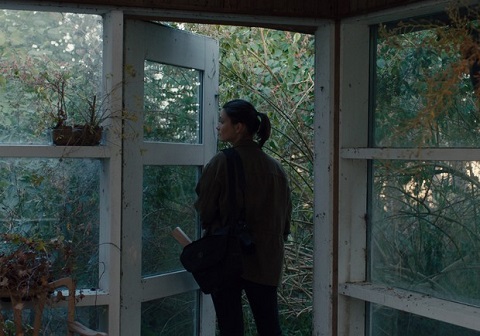
There has been a tunnel link planned between Germany and Denmark for some time, and now it seems work is about to begin in earnest as the construction boats in a group of Polish labourers to toil on the project. But they are not the only ones brought in, for a writer and researcher called Dara (Lisa Loven Kongsli) has arrived as well to record the views of those Danes who have to leave their homes to make way for the site, moving into new houses which some are quite happy to do, but others feel more connection to the location and regret having to abandon it. Dara takes this further as she picks her way through the empty buildings and discovers a treasure trove of someone's entire life, in the form of a set of journals there...
Horror writer Clive Barker had it that each and every one of us is a book of blood: when we're open, we're red. Writer and director Anna Sofie Hartmann had a similar, if nowhere near as gory and macabre, view of humanity, believing that every individual has had a life that could fill a book should they ever wish to set it down, and that made every life valid in the great scheme of things. But the pity of it was, almost all of the entire population of the planet throughout history would never get the chance to make that kind of impression, mostly because there was simply no way we could all focus on those billions of people, but also because the technology had not been present to assist that kind of cataloguing throughout their lives.
From the late twentieth century onwards, of course, we have had the internet where countless folks go online to try to make precisely that sort of impression on everyone else, the irony being that unless you do something extraordinary, or extraordinarily bad or stupid, you're not going to have any impact whatsoever. Maybe you're adept at a turn of phrase to keep you in some thoughts, but the journal Dara finds and narrates in fits and starts throughout the film was never going to be found by anyone until sheer chance allowed her to stumble across it, and if this was about anything it was about the shapes you fail to make with others' lives as the actress interviewed real Danes and Poles in the guise of her character, recording experience that otherwise would not have mattered even for a few seconds, or minutes.
A romance is contrived here between Dara and a younger Polish labourer which offers her a thrill, and would not have happened had this tunnel project not been instigated, just as you would probably have never heard of the tunnel itself if you were not a local had Hartmann not made this film. And even then, it was not exactly a blockbuster, it played the odd festival and went to specialist streaming services where it could easily be ignored as it would be investigated by the curious. This issue that everyone deserved to have their story heard did not quite stand up to scrutiny - if you went down too far that route that meant every bigot in the world had carte blanche to spread their message of hate merely thanks to every voice needing to be heard as equally valid. One element the film did agree with was that we were not all equal, we were not all given the same platform, maybe because there were a limited amount of people who wanted to listen - but there are plenty who wish to broadcast. As it was, a contemplative, oddly reserved and placid rendering of a subject that could have been impassioned and hotheaded.