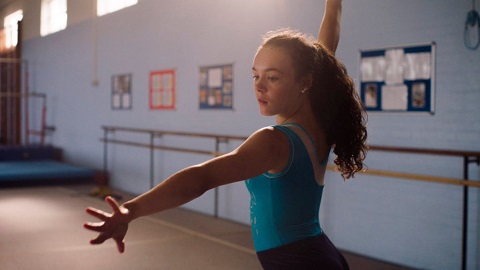
Leigh (Frankie Box) is a fourteen-year-old whose drifting life is only really anchored by her love of gymnastics, which she takes classes in with the hopes she can compete on a professional level. But even though she has an understanding tutor, Gemma (Sharlene Whyte), who knows that Leigh is struggling somewhat thanks to bullying and a father who neglects her now her mother has passed away, she is not as accomplished as she can be, probably because of those things. So when she returns home one day, and is practicing when a stranger enters the house, she is alarmed to discover he is Joe (Alfie Deegan), the older half-brother she never knew she had, which puts her heavily on the defensive.
But is the new presence of Joe a good thing or a bad thing? Perfect 10 was the first feature from Scottish director Eva Riley, graduating from acclaimed short films to a picture that was fairly brief in its running time, under an hour and a half, but its brevity gave it more focus and prevented it from wallowing in what could have been some very overused clichés of British working class cinema. You know the type of thing, the dabbling in crime, getting wasted, getting into fights, they were all over the social realism genre and not exclusive to Britain's cinema, and there are some who would feel we had seen enough of this side of life.
But Riley had the advantage of bringing a genuine energy and empathy to her characters: we were not simply watching passively and tutting at the bad behaviour they got involved with. Half of that was Riley's direction and writing - some made valid comparisons with Andrea Arnold's work - but the other half was the canny casting of Box in the lead. This poor soul ended up with a serious medical condition that necessitated an operation she had to crowdfund to put right, since the NHS were unable to pay for it for her, a state of affairs that could have jeopardised both her movie and her gymnastics career; happily she recovered, but if you liked a little human interest backstory to your films, then there was a tale that added publicity to what was already an impressive performance as it stood.
She didn't get to do a huge amount of gymnastics in the bulk of the plot, but what she did enhanced it since we could recognise Leigh had talent that needed to be nurtured, and more pressingly, she could lose all her opportunities if she follows a life of crime. Therefore what could have been an unsympathetic tearaway becomes very quickly someone we want to see succeed, but as is the way with this kind of drama, she has to stumble before she can pick herself up and continue on a more promising direction. Joe is both part of the reason Leigh starts to be led astray, and also why she begins to see a bigger picture as far as her life is going, for he is involved with low level vehicle crime that, eager to please in her misguided way, she offers to help with.
We are constantly aware that this could all turn out very badly for her, and the film adopted a parental concern for Leigh that her actual parents could not provide, an intriguing position that generated concern in us as well. Riley was lucky with the weather, so captured some pleasing pastoral shots when the pair of half-siblings venture out of the town, and if there were the occasional exchanges that fell a little flat, you were sufficiently invested in the girl's dilemma not to mind, for she is obviously painfully lonely and we are kept uncertain whether she is going about the right method of alleviating that problem. It could have been hackneyed, but the style, even compassion, delivered quality that despite from some angles resembling a remake of Ken Loach's classic of the form Kes with gymnastics instead of a kestrel as the motivating factor for the youngster's enthusiasm, was enough of its own thing to make it well worth your while, especially if you liked gritty, slice of life stories. Music by Terence Dunn.