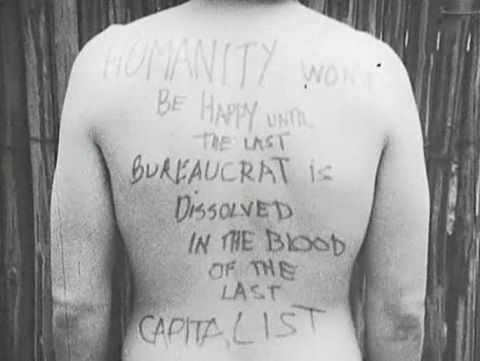
It is the near-future, and in New York City of an America that has become a police state, it has become necessary in the minds of some of its younger citizens to turn to insurgency as a manner of protest. To them, the only way forward to take back their nation is armed response, and though they abhor the random acts of terrorism that a number of their comrades may be opting for, they will still pick up weapons to fight back against the fascist leaders who have clamped down on any kind of discontent. This is the only reasonable response to a totalitarian society, they believe, and will take that battle to the street if they can; first, however, they must assemble before they mobilise, and work out their demands.
Robert Kramer was a self-styled revolutionary himself who employed celluloid to create that rebellion he so craved, though as ever with the rebellious, one wonders how far they would like that to go, as for instance, what would you be willing to give up in the name of a complete change in your society spearheaded by yourself? It may be a myth that Benito Mussolini got the Italian trains running on time, but would you trust a man with a gun screaming about bringing down the government to keep the supermarkets stocked, water flowing from your taps and the power on? The revolutionaries we witness here in what Kramer was endeavouring to keep as realistic as possible did not exactly fill you with confidence that they could achieve any of those essentials.
And one problem that Kramer could not have foreseen is plain in the twenty-first century: what if it were a paranoid far right that was positing itself as the revolution? The subject matter of nineteen-sixties and seventies underground movies like Ice would have seen them as the enemy as much as the Government, and you could argue many of the far right insurgents were informing those Governments anyway, but they had adopted the style and approach of the lefties like Kramer (here mostly preserving their anonymity) to secure their goals, and all the talk of having their rights under threat in this film and others like it had been co-opted by the other end of the political spectrum to latch onto a victim culture that was far more effective than anything Kramer could have dreamed of: if was all horribly ironic. Though it was worth pointing out there was no internet equivalent in 1969, and hardly anyone in science fiction foretold that.
Quite apart from anything else, Ice failed to make much of a case for itself and its ideals anyway. At over two hours long, and with threads of arguments that trailed away or were cut off to render it almost impossible for anyone but the most dedicated follower of the underground to follow, and all shot in murky 16mm black and white to boot, it remained one of the hardest to sit through experiences of its kind. You can certainly make a case for it validity on a political level should you so desire, but as an entertainment, which would have helped its pleading immeasurably, it was a complete dud. Time and again a burst of action, usually involving firearms but with weirdly sexually abusive attacks as well (good luck working out what that was connected to in the plot) would give way to yet more gabbing which the participants may be engaged with, but hardly anyone else would be, and satirical points about the domestic arrangements were lost in a sea of bafflement; not even the occasional sex scenes, included because they were out of the mainstream and therefore radical, could liven it up. Ice was a relic, one for the sociologists.