The modern Germany has been blighted with terrorism in recent years - or has it been improved by the terrorists? Wealthy businessman Peter Lurz (Eddie Constantine) believes the latter to be the case, since he was doing very well financially the more his clients were paranoid about being attacked, for he sells computers and surveillance equipment designed to offer peace of mind for those in need of security. His secretary is Susanne Gast (Hanna Schygulla) who doesn't think he knows a secret about her: she is actually one of the terrorists, and her cell are planning to kidnap Lurz both as a political act to make a statement against society, and to raise their profile now there is a vacuum in the European terrorist world they feel they can fill...
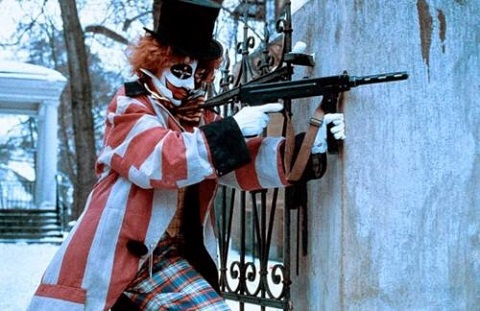
One of the hardest to watch entries in director Rainer Werner Fassbinder's canon, or rather, one of the hardest to listen to, as he populated his soundtrack with a cacophony of voices chanting away to make this more difficult to endure as part of the film's sense of humour. For some, this was a comedy, sending up the would-be consciousness raised classes who he posited would be taking over from the Red Army now time was moving forward to the next decade of the nineteen-eighties, as they came across as singularly not up to the job in Fassbinder's view. Indeed, the disdain he had for his characters was plain across every scene, to the point that the troublemakers eventually dress as clowns to underline their farcical methods and beliefs.
Obviously not for mass consumption, but at the time actual German troublemakers took great umbrage anyway, and tried to stop it being shown to the point of using violence, back when releasing films could have a sense of danger about them and had not been usurped by the more incendiary online videos for would-be insurgents and conspiracists to head for their head-feeding information and outrageousness. If it seems like another world, then watching The Third Generation it is tough to accept that anyone even back then thought a film could have changed that world, and in the decade of Ken Russell, Pier Paolo Pasolini or Jean-Luc Godard doing their damnedest to shake up the complacency they saw around them. But the seventies were also a decade which propagated the notion we should all be politically engaged.
If only to have something to discuss around the tables of the dinner parties of the era, much as the middle-class characters tend to do here. In a Godardian style, Fassbinder took a potshot at the bourgeoisie and envisaged what it would be like if that engagement of the socially aware was translated into actions, and the results were pure farce. This lot are a bunch of humourless bores, pretending to be enlightened yet acting out limited relationships that descend into chauvinism, indolence and fear when they are called upon to put their money where their mouth is, and to makes matters worse they are unintentionally at the beck and call of the powers that be who find them useful idiots in sustaining their bases of influences. How this links to terrorism as we know it in the twenty-first century was a matter of conjecture, but you cannot imagine Fassbinder being too impressed with the religious motives either, yet as he does not provide an answer to the issues he raises, he could be accused of complacency. Bizarre, incredibly awkward and few people's idea of a good time, but this was sharp as a blade in criticising its targets. Music by Peer Raben.