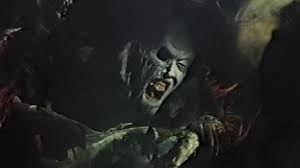
Television producer and single father Kazuo Hoshino (Shingo Yamashiro) brings his teenage daughter Emi (Nokko) along with a film crew to visit the old abandoned mansion of famed artist Ichiro Mamiya. Led by long-suffering but dogged co-producer Akiko (Nobuko Miyamoto), haughty TV host Asuka (Fukumi Kuroda) and randy cameraman Ryo (Ichiro Furutachi) set out to film themselves restoring Mamiya’s precious frescoes. Until a string of horrific paranormal events betray the presence of a malevolent spirit: none other than the late artist’s wife, Lady Mamiya. Trapped by the ghost the terrified TV crew must figure out what she wants in order to survive.
Otherwise known as the other infamous Japanese haunted house movie besides Hausu a.k.a. House (1977), Sweet Home is an excellent, visceral yet intellectually nuanced horror film in its own right. Sources differ as to whether the film sired Capcom’s fan-favourite survival horror role-playing game or was an adaptation thereof. Either way the story-structure of both went on to strongly influence the company’s later, more renowned Resident Evil franchise. In other words the blame for all those CG amped-up Milla Jovovich zombie-slay-a-thons rests here. Well, maybe not. That dubious legacy aside Sweet Home remains among the most ambitious horror productions ever mounted in Japan, both technically and thematically. Its bigger than average budget extended to elaborate special effects orchestrated by The Exorcist (1973) maestro Dick Smith. These splatter sequences, most of which involve bodies putrefying in spectacular fashion, are staged with flair worthy of Italian genre mavens Dario Argento and Lucio Fulci. Only imbued with the kind of surrealistic flourishes one only encounters in Asian horror.
Which leaves it all the more surprising director Kiyoshi Kurosawa all but disowned the film. Chiefly because while making it he suffered a similar fate as befell his filmmaking idol: Tobe Hooper on the set of the Steven Spielberg-produced Poltergeist (1982). Here producer and uncredited co-writer Juzo Itami had far greater control. At the time Itami, who also essays a hammy supporting role in old-age makeup, was Japan’s most internationally acclaimed art-house auteur famed for his satirical comedies Tampopo (1985) and A Taxing Woman (1988). Meanwhile Kurosawa had a pair of critically acclaimed "pink films" to his name but was still largely seen as a neophyte. Certainly the fast-cutting, swooping camera-work, visceral gore, emphatic score and readily accessible characters and storyline are all radically different from the style of filmmaking Kurosawa chose to pursue in his later career. Subtler, more esoteric, introspective and personal films like Cure (1997) and Charisma (1999) would eventually see him acclaimed as a maker of art-house chillers along the lines of David Lynch.
On a surface level, especially compared to Kurosawa’s later films, Sweet Home seems like much more of a Spielbergian thrill ride, placing its focus on spectacle and visceral fright sequences. The film paints in broad strokes with wide-eyed performances and a tone that evolves into full-blown crash-bang-wallop hysteria once the scary stuff starts. Its darkly comedic undertones, while less in-your-face than in Hausu, may likely also rile genre fans uncomfortable with this key facet of pre-Ring (1998) J-horror. Yet Sweet Home is not a vacuous spook show by any means. Indeed it shares thematic preoccupations in common with a sizable portion of more ‘respectable’ Japanese cinema. Interestingly as was the case with Hausu’s story, its key themes are motherhood and representations of femininity. The plot hinges on two contrasted mother figures: the vengeful ghost of Lady Mamiya and Akiko. One a traditional archetype twisted by bitterness and rage, the other a ‘modern woman’ distinguished by her empathy. Each of these women proves willing to risk all for the sake of protecting their child. In Akiko’s case a child that is not literally hers.
Outspoken, resolute, tender and brave, Akiko emerges the most faceted character in Sweet Home, vividly portrayed by Nobuko Miyamoto, Juzo Itami’s wife and frequent female lead in his films. Co-star Nokko also acquits herself very well in a role very different from her sultry stage persona as lead singer with Eighties J-rock band Rebecca. Indeed the finale revolves around Emi displaying the empathy and moral clarity the plot signals as crucial heroic traits throughout. By comparison Sweet Home’s most notable male character, Kazuo, is drawn as something of a doofus: selfish and immature. The film makes it clear how his immaturity has forced Emi to step into the maternal role and thus aged the teenager before her time, leaving her susceptible to the sinister vibes of Mamiya mansion. As such Sweet Home functions as a deft satire of why the patriarchy needs to stop constraining women along with proving a kick-ass gory horror film.