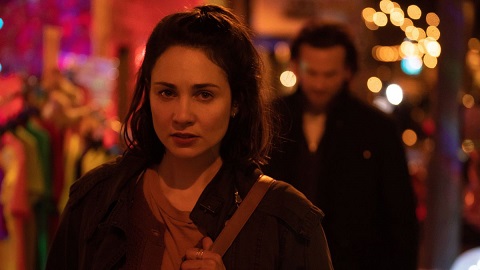
When Abby (Tuppence Middleton) was a seven-year-old, she was out fishing with her family by the river around their Canadian hometown of Clifton Hill when her father gave her a catch in a bucket and told her to go and fetch some water for it. Off she went into the woods near the road, but as she reached the tap she realised she was being watched, and looked around to see a boy, older than her, who had one eye bloodily bandaged; he signalled her to be quiet, but it was no use, for a couple pulled up in a car and bundled him into the back of it, then sped off. Ever since, she has wondered about that memory of what she saw: was it real? Was someone kidnapped? Can she trust her memories at all?
Now her mother has died, and she has inherited her hotel, she returns home, which kicks off the story, and what a can of worms it was. Disappearance at Clifton Hill was a curious little mystery that took a novelish approach to its tale, unfolding much as one of those popular thriller paperbacks would with twists, turns, digressions and an emphasis on the personality of the main character which may be more mercurial than initially appears. The unreliable narrator trope was by no means a new one, but here we were invited to be an unreliable observer as the conundrum Abby is trying to fathom grows ever more complex, to the point that even at the conclusion the viewer is not entirely certain they have everything worked out to their satisfaction.
However, it was difficult to discern if this was by design or whether director and co-writer Albert Shin merely allowed his material to run away from him too far. Actually, there was quite a bit difficult to discern about this, in a way that was possibly influenced by David Lynch and Mark Frost's Twin Peaks, with its town holding sinister secrets and a would-be detective uncovering ever more convoluted explanations for what it going on. What doesn't help Abby's case is that she is a compulsive liar, and we get a hint that all is not well mentally when she takes a stranger she has met in a bar back to her room for sex, only to put him right off just before they get down to it by claiming to be a virgin.
Every one of her eccentricities - or perhaps mental issues that she is suppressing - has a repercussion later: for instance, the stranger is in town to get a job, and turns out to be Officer Singh (Andy McQueen), who is the sceptical policeman she has to ask about the disappearance of the young boy she saw way back in 1994. Shin was consciously throwing in aspects that were plainly designed to disorient the audience, so much so that you were often tempted to wonder if you were following the narrative with the correct rigour, even if you had picked up on every little plot point: at one point Abby is wandering by the river (which is in the Niagara Falls area) when Canada's most famous film director David Cronenberg emerges from under the water and walks up to her to recommend his podcast.
He was playing a conspiracy theorist, except he may have some justification in believing there is a plot going on to cover up various crimes, some committed by the local millionaires, others by a husband and wife magician team who Abby comes to suspect were the parents of the boy she saw kidnapped, and have fed him to their Siegfried and Roy-style pet tiger used in their act. All of this comes across as important, but the message would seem to be that with the barrage of information we are faced with every day, how are we supposed to perceive anything like the truth? It would be perfectly understandable if you lost patience with Disappearance at Clifton Hill with its endless confusions within confusions, and as indicated, it was not to all appearances content to play the obvious game, but Middleton struck a compelling figure as a vulnerable investigator we are not sure we can trust, and the atmosphere of a rundown location was strangely unnerving. Music by Alex Sowinski and Leland Whitty.