Doctor Allan Barnes (Paul Stevens) has been seeing a psychiatric patient, Michael Radin (Martin Lavut), who has been complaining he cannot tell the difference between reality and fantasy: last night he dreamt he was stalking a young woman who he chased into the forest and strangled, though not before she scratched wounds into his cheek with her fingernails. He has no idea if this was actually a nightmare or if it happened, but he does have the scars on his face which he received from... somewhere. Barnes believes he knows what the problem is, an ancient artefact in the form of a mask that Radin has in his possession, and appears to be warping his already fragile mind, so how about the doc gives it a try himself?
The Mask, not to be confused with the not-dissimilar but far less horror-oriented Jim Carrey blockbuster of the nineteen-nineties, was the brainchild of a former documentary maker named Julian Roffman, a forgotten man now, but one of the main players in getting a Canadian film industry off the ground. This was his passion in life, and he succeeded in realising it, though at the cost of any renown whatsoever, despite having had this item as not only the first Canadian film to be distributed in the lucrative United States market (it also belatedly made it to Europe and did well there, too) but the first Canadian horror movie too, and this about ten years before David Cronenberg started to make his singular pictures.
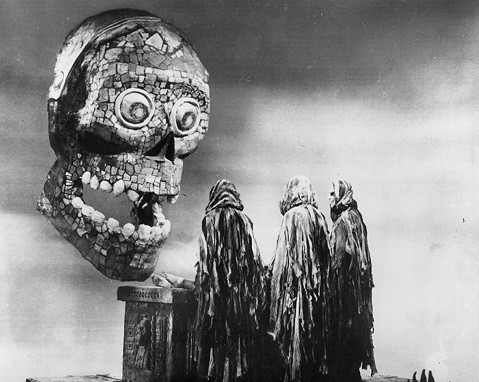
The Mask was essentially a gimmick movie, and that gimmick would have been hot property in the mid-fifties but was a shade behind the times come 1961: 3D. Had you gone to see this in a theatre on its release, you would have been given a cardboard mask with special lenses in the eyes, all the better to view the three dream sequences Roffman concocted. The main complaint made about this was that all the focus was on the nightmares and the rest of it, an hour of screen time at least, was merely padding, and it was accurate to observe much of the non-3D material came across as the filmmakers treading water and filling up the too-lengthy spaces in between the visual highlights. This told the tale of Dr Barnes after his patient commits suicide and posts him the titular mask in the mail, whereupon the shrink grows addicted to its effects.
There was a show of philosophising about the nature of evil as our hero's personality changes radically for the worst after exposure to the object, and loose thriller sequences where he almost (but doesn't) strangles the two women in his life, but the film was under no illusions about why you were here: you wanted to see the 3D. And it was worth waiting for, as they may have had hardly anything to do with the rest of the plot, but they were very entertaining and well-thought out considering they were achieved on a tiny budget. You had the expected stuff flying at the camera, but the sense of depth was highly effective, and if it was all dream sequence business that had little to connect to any psychology as science would recognise it now (or then), the skull-based shenanigans did prove very diverting and the giant-sized mask was a striking, even unnerving image. If you didn't have the patience to sit through the other scenes, it was possible to track down the 3D bits on their own, assuming you had the correct glasses to make the best of them. Proof that even mediocre movies can have their bright points. Music by Louis Applebaum.