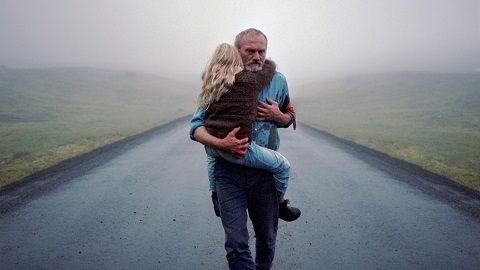
Ingimundur (Ingvar Sigurdsson) is an ageing policeman in Iceland, who has been putting a brave face on his recent bereavement by throwing himself into the renovation of a remote farmhouse he wants his daughter and granddaughter to live in, rather than sprucing it up for his own purposes. But of course this is for his own purpose, since once his late wife had her car accident - somehow she managed to drive off a road in heavy fog, through the crash barrier and down onto the rocks below - he has been struggling to admit to himself that he is suffering very badly from grief. Will anything soothe his tattered emotions? How about a shallow grave and a loaded shotgun, will that do?
Often when something bad happens to people, they look around for someone to blame, either because they suspect there was someone responsible, or they simply cannot admit to themselves that they had responsibility as well. Or even sole responsibility, but as far as we can tell from the opening half hour or so, Ingimundur had nothing to do with his wife's demise, yet still he must punish himself and those around him for what happened, more or less without admitting to himself that it what he is doing. This film was essentially the tale of what a man can do when he is driven to a mental breakdown and after internalising his feelings, he lets them out to disastrous effect.
So... Icelandic bereavement drama. Doesn't sound much fun, does it? And for many who saw this, you imagine they would merely clock the misery and decide it was not for them, a perfectly reasonable response, yet director Hlynur Palmason was nowhere near as straightforward as that, bringing up asides and choices that were not simply arresting (pardon the pun, with its cop protagonist) but bizarre, even humorous. Not everyone saw that humour, but once you noticed it was there, despite the tragedy it was dealing with and depending on your tolerance for black comedy, A White, White Day began to strike you as increasingly funny, even laughter-inducing.
We were talking about a film which ended on a note of epiphany involving gratuitous nudity played out to the strains of the oddball Leonard Cohen and Phil Spector collaboration Memories, from the Death of a Ladies Man album, which too had gratuitous nudity in lyrical form, and the effect was curiously uplifting as the credits rolled no matter that we suspected we were looking at a man who had ruined his own life. But his life was ruined for him first when fate intervened, what tipped him over the edge was the suspicion his beloved missus was having an affair, and this makes him hopelessly paranoid to the point of scheming against those who he should really be accepting support from. As it was, the only person he can really rely on is his granddaughter, Salka (Ída Mekkín Hlynsdóttir).
This renders the scene where he finally pushes her away in a fit of rage all the more heartbreaking, and it's a very well-acted bit amongst a plethora of them (Sigurdsson is one of Iceland's most respected thespians in his homeland, and you can well understand why). It does take a while to get a handle on, particularly if you were not attuned to the Scandinavian mood, but once you settled into its deadpan groove it began to blossom before your eyes, from its diversions to the world's most morbid children's television show (and you thought Iceland was all bright and upbeat like Lazytown) or the journey of a rock down hillsides and cliffs before dropping with a plop into the sea off the coast. The scenes where our antihero cracks and, for instance, smashes up the video link for a grief counsellor, or attacks his fellow cops in the station, would have been harrowing in other hands, yet here, when you can sympathise with his frustration, they turn weirdly hilarious. It's a balancing act few would even consider trying, and it impresses. Music by Edmund Finnis.
[Peccadillo Pictures release this on select digital platforms on July 3rd.]