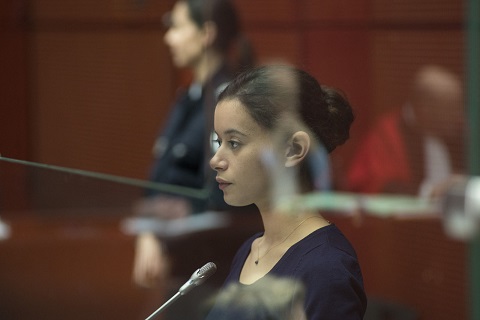
A couple of years ago, at a family holiday on the beach in France, the Batailles had a shock when the teenage daughter Lise (Melissa Guers) was abruptly taken away by the police who arrested her for murder. It turned out she was accused of the killing of her best friend, and now the trial is due to begin, the girl studying for it as she would an exam at school, only now it is her freedom and guilt or innocence that is at stake. She denies that she had anything to do with the crime, but there has been a lot of conflicting evidence and even her parents (Roschdy Zem and Chiara Mastrioanni) are not entirely sure how innocent the girl is, so will a court case be able to make sense of the attack?
Maybe the point is to ask whether a court case can be used to be certain of anything concrete when it comes to the trickiest of cases, and further than that, are there any murder cases that are not tricky? Director Stephane Demoustier took it upon himself to pose some disturbing enquiries about precisely how far we can trust a justice system that relies so heavily on the testimony of witnesses and the accused which may be accurate, yet may not be, revolving around recollection that could be faithful to the facts as they stood, but then again may be reliant on fuzzy memories, memories clouded by trauma, or at worst, outright lies and fooling the jury to make sure the accused goes free.
While the trial depicted in The Girl with a Bracelet, or La fille au bracelet as it was called in its original French, did reach a conclusion, and we were left in no doubt what the jury thought, the matter of whether you agreed was something different, as you could legitimately have an issue about how justified that conclusion was. Will there be a miscarriage of justice, or will that justice be served? One thing was for sure, a teenage girl remained dead and was not coming back no matter what the verdict was, and Demoustier could be accused of being a little too tricksy in that the tragedy at his story's heart, however fictional, featured a tragedy that echoed real life accounts.
The courtroom drama was a genre that was more often relegated to television, Perry Mason springs to mind, or Rumpole of the Bailey, even Crown Court if you wanted to go back to the nineteen-seventies, but there were cinematic examples too, Billy Wilder's Witness for the Prosecution loomed large, as indeed did Otto Preminger's Anatomy of a Murder, more pertinently to this in fact, for there was a sexual angle to the killing. The victim had not been raped, but she had, it is revealed in the dialogue, had sex with Lise the evening before she was found stabbed to death the morning after, something that comes as an uneasy surprise to her parents and some of those older members of the courtroom, though perhaps crucially, not to the characters of Lise's age. Is she a "slut" as the parlance has it?
As well as the Preminger, there was an aspect of the fifties juvenile delinquent shock horror movies, the ones where youngsters' behaviour was accused of being a threat to their society that took great pleasure in punishing the culprits, as much for enjoying a liberated lifestyle away from the parental gaze as it was for the murder or whatever crimes they were accused of. The worry that your child is irresponsible, and more than that, unable to be related to with any morality you understand, was shot through what could have been a very dry experience, but with the reserved approach came a focus that rendered the film intriguing and at the same time chilling. It was patently designed to start hotly contested conversations once it was over, and that may have been more valid had it been about a real case instead of based on a recent Italian script, yet nevertheless in Guers it had a focus of icy fascination, you truly cannot fathom her, and the "tell" we are offered in the final shot can be read both ways, just like almost everything else in this troubling effort. Music by Carla Pallone.