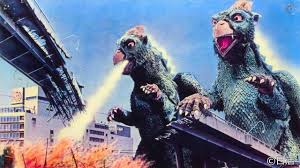
Magazine reporters Hiroshi Kurosaki (Tamio Kawaji) and Sanburo Hayashi (Kokan Katsura) and winsome photographer Itoko Koyanagi (Yoko Yamamoto) accompany a scientific expedition exploring a remote island on the South Seas. When the team discover a newly-hatched giant prehistoric beast the natives dub ‘Gappa’, Hiroshi elects to bring the creature back to Japan. Despite the stern skepticism of his love rival for Itoko, Professor Tanaka (Yuji Kotaka), and ominous warnings from the superstitious islanders including native boy Saki (child actor Masanori Machida in lamentable blackface). Back home publishing magnate Funazu (Keisuke Yukioka) is excited to use Baby Gappa as a promotional stunt for his new family theme park Playmate Land (one imagines Hugh Hefner’s lawyers have something to say about that name). Unfortunately it turns out our foolhardy heroes unwittingly angered Mama and Papa Gappa. Twice as large and ten-times more destructive, the enraged parents burst out from hibernation and fly to Japan, bent on teaching those baby-snatching humans a lesson.
Nikkatsu, Japan’s oldest film studio, were in the Sixties known for their youth-oriented musicals, westerns (yes, really) and action films starring the leading idols of the day. Later in the Seventies and beyond the studio became infamous for their slew of sleazy albeit glossy (and, in some instances, critically-lauded) ‘Roman Porno’ sex films. Monster from a Prehistoric Planet (a nonsensical title given the planet in question is Earth!) also known as Gappa, the Triphibian Monster (whatever that means) was Nikkatsu’s lone venture into the kaiju eiga or giant monster genre otherwise dominated by rival studio Toho. Released stateside by drive-in kings American International Pictures, it shamelessly rips off the earlier Anglo-American film Gorgo (1961), directed by giant monster specialist Eugene Lourié.
Like the Lourié film Gappa is a light-hearted affair, lacking the doom laden atmosphere of the early Godzilla outings. However it has much of the same comic book whimsy and colourful sense of fun abundant in Toho’s later films, notably Mothra (1961) and Godzilla vs. the Sea Monster (1966). The brash entrepreneur-seeks-monster-for-star-attraction-in-their-amusement-park angle central to Iwao Yamazaki’s script obviously echoes King Kong (1933) but also anticipates Jurassic Park (1993) and, oddly, Tim Burton’s live-action remake of Dumbo (2019). No slapdash cash-in by any means, the film is competently assembled by Haruyasu Noguchi (a director more active in period yakuza films) with handsome production design, several nicely executed set-pieces and a jazzy, freewheeling identity distinctly different from Toho fare. Its rubber monster suits and miniature effects, while not up to the standard set by Toho’s Godzilla series, remain engaging and effective. Indeed the giant bird-beaked trio of Rodan wannabes (whose appearance also evoke Japanese folkloric creatures like the Kappa and Tengu goblins) are downright endearing.
Champions laud the film as a satire of venality and recklessness within the media and entertainment industry. Yet its impact is blunted and muddled by the presentation of smiling, affable Hiroshi as both blundering fool and stoic hero whilst sidelining scientist Tanaka who ought to serve as the voice of reason and moral authority. For all its good intentions the film also features the same casual racism that mars vintage Hollywood adventure fare. It is also laden with silly subplots, including the tepid love triangle, and goofy comedy. Mostly centred on the antics of blustery J. Jonah Jameson-like newsman Funazu ("This animal belongs to me and I can do what I want with it!") Funazu, who at one point shocks Baby Gappa with an electric cattle-prod, proudly remains an obstinate asshole right to the fade-out. Even when faced with the tearful pleas of his little daughter.
To the film’s credit it is a rare monster movie that acknowledges its protagonists are firmly in the wrong. Yet proves generous and humane enough to forgive humanity’s mistakes. As the third act devolves into an admittedly fun orgy of destruction, with Mama and Papa stomping through Tokyo spewing death-rays at fighter jets, it is neither military might nor scientific ingenuity that proves humanity’s salvation. Rather it is humility and decency in the face of nature’s wrath. It wraps up with a surreal, slightly silly, but charming finale marred only by a closing admission from heroine Itoko likely to make most modern viewers, let alone feminists, wince. Sadly M.I.A. from American International Pictures’ English dub is the film’s original Japanese surf rock theme song.