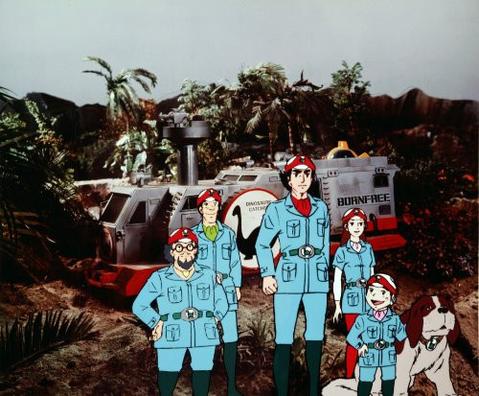
No, it's not the Sixties film about Joy Adams raising Elsa the lion. This one is a little different. In the far-flung future a meteor narrowly misses colliding with Earth. Unfortunately its magnetic pull triggers devastating tidal waves, volcanic eruptions and earthquakes that rip open the Earth's crust. From whence emerge all kinds of strange prehistoric vegetation and along with dinosaurs, somehow siring a new Mesozoic Age! With ferocious giant reptiles stomping around Japan the call goes out to a dino-wrangling task force. Stoic Joiji Kitayama (Katsuji Mori) leads the team as they travel aboard a high-tech super-vehicle nicknamed 'Born Free' capturing dinosaurs for transportation to a remote island, safe from harm.
Kyoryu Tankentai Born Free was made by Tsuburaya Productions, the studio behind Japan's most enduring superhero franchise: Ultraman. The twenty-six episode serial (re-edited into a feature film release with a bad English dub as Return of the Dinosaurs) formed the first part of what became a loose conceptual trilogy of shows mixing live-action sets, rubber dinosaurs and high-tech vehicles with cel animated human characters. It was followed by Dinosaur War Aizenborg, released in America as a re-edited feature film titled Attack of the Super Monsters (1978), and the most popular entry Koseidon (1979). Which has a reboot on its way. Unlike those later serials Born Free was conceived with a modicum of educational value. Hence the plot pauses between dino encounters so our cast of stock science patrol types (smart guy, clumsy guy, token girl, kid sidekick with dog) can cheerfully lecture the audience about prehistoric flora and fauna along with stressing the importance of animal conservation and safeguarding our environment.
In many ways Born Free was ahead of its time with its pleasing eco-friendly message. Instead of fighting giant dinosaurs like so many of their tokkusatsu (Japanese special effects shows) brethren these heroes rescue and protect them. An early sequence has Joiji and company dealing with an angry brontosaurus they eventually discover is only protecting her offspring while the finale pits them against amoral high-tech big game hunters out to bag themselves a dinosaur for their private zoo. However while the pro-environmental themes went down well with parents and teachers, kids at the time were mostly tuning in for the show's roster of cool-looking super-vehicles. Alongside the titular transport the team also have at their disposal an eccentrically-named aircraft called "Carry Donkey", the submarine "Super Shark" and a helicopter dubbed "Seagull."
With Tsuburaya's staff of seasoned effects artists on the case we get impressive miniature vehicles, cities, jungles, earthquakes (the show was released after Toho Film's mega hit The Submersion of Japan (1973) kicked off a wave of disaster films in Japan) and of course dinosaurs. Unusually while Born Free utilizes the standard rubber suits for close-ups most of the dinosaur effects employ stop-motion animation. Mixed with the anime-style human characters and transforming sci-fi vehicles the result is an eye-catching albeit eccentric melange of effects techniques. Unfortunately the feature film version is also clunky and slow-paced, lingering on dull scenes of toy trucks ambling to and fro. It is overlong with a plot that is invariably repetitive given this was condensed from multiple television episodes. There are a handful of exciting sequences, including a scene where a character is caught by a carnivorous plant that is part stop-motion, part cel-animated, but whiplash mood swings along with the comically stilted English dub (Jouji, rechristened George in English, sounds like he had a lobotomy) made this a target for the MST3K crowd.