While a boat-load of passengers listen to a braggard (Kunie Tanaka) recount a racy story about the time he supposedly saved a woman from rape, an unscrupulous pickpocket steals a man's wallet. Caught in the act, he bullies and beats the terrified travelers who cower in fear. Until Zatoichi the blind swordsman (Shintarô Katsu) cuts off the thief's hand and tells him to stop acting like a dick. Arriving in the Serigazawa region Ichi prays at the local temple, urging the gods to keep him from having to kill again. Alas, only moments later Ichi is attacked by Eigoro (Hisashi Igawa) whom he dispatches with swift ease albeit no small regret. Curious as to why a complete stranger wanted him dead, Ichi follows Eigoro's horse home only to have Okichi (Michiyo Yasuda), the dead man's beautiful sister, try to stab him too. Instantly remorseful when Ichi refuses to defend himself, Okichi shelters the blind swordsman and nurses him back to health. Whereupon Ichi takes Eigoro's place protecting Okichi from a brutal yakuza gang out to take over the town.
Also known as Zatoichi's Ocean Voyage, Zatoichi's Pilgrimage is another solid entry in the long-running chanbara series. Kazuo Ikehiro, a veteran of chanbara films from the early Sixties all the way to the present day (though he was also active in contemporary action thrillers and even directed episodes of cult TV show Monkey! (1979)), returns to the fold having previously directed Zatoichi and the Chest of Gold (1964) and Zatoichi's Flashing Sword (1964). Ikehiro's exquisite framing wedded to the luminous cinematography of D.P. Senkichiro Takeda brings a uniquely epic scope to this particularly outing for the sightless swordsman, halfway between Akira Kurosawa and spaghetti western maestro Sergio Leone. However, the most notable presence behind the scenes is scripter Kaneto Shindo who, when he wasn't penning scripts for feted filmmakers from Kon Ichikawa to Tadashi Imai, was a major auteur in his own right. Best known for his sensual supernatural horror films Onibaba (1964) and Kuroneko (1968), Shindo remained an active, relevant force in Japanese cinema right up till his death at age 100 in 2012.
Much as Shindo's most celebrated films foregrounded a strong social conscience, e.g. Children of Hiroshima (1952), Lucky Dragon Number 5 (1959), the fourteenth entry in the Zatoichi series is characterized by a contemplative, near-existential mood. The film finds Ichi at his most pensive and introspective, wracked with regret for each life he has taken and so haunted by blood-stained hands he gently rebuffs a potential love interest. Low on action for the most part, even though Ikehiro pulls off numerous near-silent sequences with gripping suspense, the lengthy build-up pays off with a fairly perfunctory finale albeit visceral and well staged. At this stage Zatoichi was a more vulnerable and less superhuman yet when he takes on an entire army single-handed the outcome is never in doubt. Swaggering, gravel-voiced Isao Yamagata makes for a memorably menacing and cocky adversary as yakuza Boss Tohachi. However Shindo's touch is evident in the cynical and subtly satirical portrait of the cowardly and self-serving villagers. Led by serenely smiling pacifist Gonbei (Masao Mishima) whose manipulations in some ways leave him looking like the film's true villain.
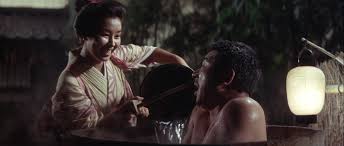
Later entries gave Ichi's libido a workout, but Zatoichi's Pilgrimage revolves around a tender, well-developed romance that proves genuinely sweet and engaging. Michiyo Yasuda's Okichi is a pleasingly gutsy and outspoken foil for Ichi and the plot charts the evolution of their relationship from hostile to romantic with some heartfelt and nuanced drama. Many of which unusually involve Okichi pranking the blind hero relentlessly! Including a mildly racy scene where she takes advantage of Ichi's blindness to disrobe in front of him for a dip in the lake. Interestingly Zatoichi's Pilgrimage also features a dream sequence in which Ichi recalls playing on the beach as a sighted child. Which contradicts entries both earlier and later that insist he was born blind. Hmm.