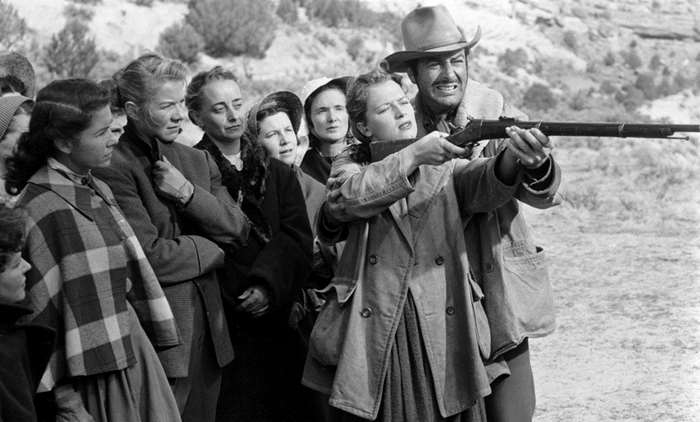
In 1851 the lonely men of Whitman's Valley, California are desperate for women. Eager to have couples set roots and prosper, town founder Roy Whitman (John McIntire) hires experienced though skeptical wagon master Buck Wyatt (Robert Taylor) to come with him to Chicago and help lead one hundred and thirty-eight "good women" cross country to California. As the journey proves arduous and fraught with a peril, a grimly determined Wyatt drives the women to toughen up if they want to survive.
Frank Capra wanted to make this western until his story was purchased by MGM. At the time new boss Dore Schary, having ousted his older, more conservative predecessor Louis B. Mayer, was intent on steering the studio's hitherto frothy output in a grittier, socially relevant direction. Schary assigned William A. Wellman to direct. Although typically though of as a manly "man's man" type of director, on the strength of the gritty verisimilitude he brought to classics like Wings (1927), The Public Enemy (1931), The Ox-Bow Incident (1943) and The Story of G.I. Joe (1945), 'Wild Bill' Wellman was as adept at crafting portraits of hard-working, gutsy, independent-minded women. Take for example his star-making Barbara Stanwyck vehicle Night Nurse (1931), crime drama Frisco Jenny (1932), romantic western The Great Man's Lady (1942) or even his larky murder mystery Lady of Burlesque (1943). In Wellman's capable hands, Westward the Women emerges one of the toughest, most grueling western dramas of its era. Largely dismissed in its day as a 'gimmick western' the film has been more recently justifiably re-evaluated. While a few notable flaws leave it a notch below a classic, the film still offers a fascinating dissection of gender politics in the American west.
Unfolding via a string of well-crafted character-driven vignettes, the plot assembles a fascinating cross-section of vivid female characters as a counterpoint to the rugged machismo of Robert Taylor's gruff Buck Wyatt. From French showgirl Fifi Danon (Denise Darcel) and her gal pal Laurie (Julie Bishop), to bespectacled sharpshooter Maggie (Lenore Lonergan), insecure unwed and pregnant Rose (Beverly Dennis), game old bird Patience (Hope Emerson) and Mrs. Maroni (Renata Vanni) an Italian widow who speaks no English and travels with her beloved young son (Guido Martufi). Each of these women shoulder their own subplots that ultimately prove more interesting than the strained romantic relationship developed between flirty Fifi and grouchy Buck (when Buck finally takes a whip to the rebellious mademoiselle who then melts into his arms, viewers will be hard pressed not to recoil in horror - or at best, stifle a groan). Wellman emphasizes the sheer harshness of the wild west terrain, the hot sun, bracing winds, arid desert and relentless storms that not only take their toll on the women, but eventually forge them into a hardy survival unit that earns Buck's respect.
Inevitably Buck's assembly of smirking sexist cowboys prove more than eager to make a move on the seemingly helpless women. Before long he has run one man off for attempted rape and shot another for going through with an assault. Yet far from solving a problem this leaves Buck fatally short-handed for the perilous journey ahead. His solution is to "make men out of these women." Which involves barking insults and, in scenes that play especially uncomfortably with modern viewers, even physically assaulting the prairie women (at one point Buck punches a grieving mother unconscious), slowly forcing them to toughen up, follow orders, handle the wagons, endure the elements and survive. On the surface the film seems to endorse Buck's no-nonsense viewpoint that the women need to sacrifice their femininity in order to survive. However, while Buck's rough treatment yields results it also fractures the women's camaraderie. They start to bicker among themselves and turn on each other. Two of the group even end up in a fist fight no different from any male rough and tumble cowpokes. At first Buck looks on smiling until rebuked by one of the film's other more sensitive and fascinating male characters.
Along with its compelling cross-section of female characters, Westward the Women also takes the unusual and fascinating step of featuring a Japanese character in Ito played by an actual Japanese actor (Henry Nakamura). Instead of a crude racist caricature, Ito emerges not only a well developed character but gutsy and outspoken. He stands as a sensitive counterpoint to Buck and surprisingly the one character that challenges his ruthless frontier survivalist values. Nakamura (who later left acting to work at the Illinois Institute of Technology designing heat resistant tiles for space shuttles and later received a commendation from President Ronald Reagan) is excellent in the role etching a character as vivid as those beautifully essayed by similar standouts Hope Emerson, Beverly Dennis, and Lenore Lonergan. Even so it is telling that come the fade-out Ito is the one man in town without a wife.
If the film is too stuck in a rigid Fifties mindset to critique Buck's macho survivalist philosophy at least the finale pulls a pleasing reversal. When the women refuse to kowtow to Buck's last demand they earn his respect. Whereupon he delivers a heartfelt speech insisting his fellow men respect the women's dignity and endurance. It stands as a heartwarming note in what is otherwise an especially hard-hitting, indeed unrelenting survival story often shockingly unsentimental about death, as Buck realizes that, rather than adopt masculine values, feminine strength was what they needed all along.