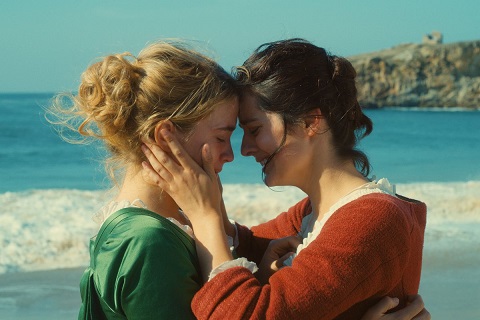
Marianne (Noémie Merlant) is an artist and art teacher, but one day when she is posing for her students, she notices one of them has taken out one of her older paintings because the student believed her tutor would want it on display. But it is plain to see Marianne is not too happy about this, since it stirs memories in her of an earlier time she is not sure whether she wants to remember them at all. As she sits for the sketchers, she recalls the boat trip to the island where Héloïse (Adèle Haenel) lived, the woman she had been hired to paint a portrait of, and how the canvas fell in the water and she had to dive in to retrieve it. But mostly she recalls the emotion of those days...
Céline Sciamma had been a critical darling with her female-centric movies for some time, but enjoyed her breakthrough, if not to the mainstream, then to a wider interest with Portrait of a Lady on Fire, or Portrait de la jeune fille en feu as it was called in her native France. So many were falling over themselves to praise her achievements here that it felt more than a little churlish to point out that the results were on the dull side, and you would have to be especially brave to voice the opinion that this was essentially the story of two women stuck on an island who grow so bored with nothing to do that they end up in bed together. If it was not quite as bad as that sounded, that was the gist.
Héloïse was played by Sciamma's ex-partner, and in the cinematography and the way it lingered on the female form it was clear from the director's previous movies that this was her preferred subject matter, since those others did a lot of lingering on females too. It was more acceptable that they were grown women in this case, and helping was the visual beauty of its simple but striking imagery which made for a very attractive two hours as far as the act of watching went. Given a portrait artwork was the catalyst for the two leads' romance, it made sense that you were prompted to examine each and every arrangement in the frame as if you were touring an art gallery rather than at a movie.
The plot was somewhat meagre, however, and more dedicated to presenting women of hundreds of years before who were allowed to let their hair down (and loosen their corsets) now all the repressive men were out of the way, at least for a week or two. Marianne has been drafted in to paint the lady of the title so the portrait can be sent to her betrothed, who basically wants an heir rather than any kind of relationship, but as we can tell will be more than pleased if his new wife is easy on the eye. Such is the subjugation women will have suffered for millennia, and will suffer for many years more unless they can find a method of standing up and breaking the patriarchy, was the message, but that kind of anger was lost in a series of pretty pictures - the landscape at the beach, the actresses artfully arranged, and so forth.
It's not as if this was a terrible film, Sciamma was too talented for that, but her pacing was altogether too leisurely and the effect was less a call to arms and more a soporific if you were not careful and unmoved by sapphic eroticism. Yes, the pace of life back then was a lot slower, but once she had her protagonists admitting what they'd like to do to one another, she had no ideas of what to do with them other than let the inevitable happen and split them up again. Once more, the pressure of the masculine on the feminine was called out, but throwing in a decidedly non-historical singalong, have the painting style be non-period specific and otherwise be about as historically accurate as an obvious influence, Jane Campion's The Piano, gave away Sciamma's mind was very anchored in the twenty-first century rather than the eighteenth, and given women were free to create art, including films, now, you did wonder what point she was drawing. Men dominated cinema, but the praise Sciamma received must prove times were a-changing, right? Get to the end and Haenel proved her worth with a perfectly acted little scene, however.