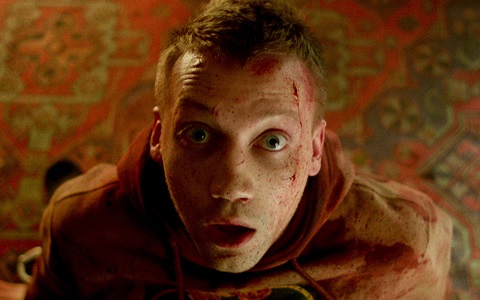
Matvei (Aleksandr Kuznetsov) arrives at the door of the apartment of his girlfriend's parents. He has never met them before, so is understandably nervous, or could those nerves be down to the fact he is holding a hammer behind his back? What does he need a hammer for? Is he going to plant it in the head of his girlfriend's father, Andrei (Vitaliy Khaev)? As he stands there, plucking up the courage to press the doorbell, a neighbour arrives in the lift with her dog which starts barking at him, and Andrei opens the door and they stare at each other. Matvei introduces himself and is invited in, sits down at the table and is offered tea or coffee - then the hammer falls out...
Why Don't You Just Die? is a question that could be directed at any one of the characters in writer and director Kirill Sokolov's debut feature, depending on whose sympathies you feel yourself moved towards, but once it is over you realise it was directed at the character who should really have been dead a long time before. The action took place in the confines of a single apartment, with occasional flashbacks to the world outside so we could fill in the blanks and understand the motivations that have brought us to this point, but somehow the film did not feel as if it was cheating the audience by restricting itself so much, probably because its obvious influence was Quentin Tarantino's debut.
Reservoir Dogs had been a marvel of economy as it largely took place in a warehouse set, again with flashbacks to ensure we knew what was happening (eventually), and relying on a series of twists to sustain our interest in a bunch of people we would be better off crossing the road to avoid. The thing was, they do seem outwardly, well, respectable: Andrei is a police detective, for example, and there's nothing in any one person here who would come across like anything other than an ordinary Russian citizen. This, of course, was Sokolov's point, the supposedly reasonable, law-abiding fellow countrymen were concealing a corruption that went so deep into the nation it was supposed to appal.
The idea that even those who present themselves as good and decent members of society when they are harbouring a seething hatred that crushes their sense of correctness and civility and allows them to excuse themselves a collection of ghastly behaviour was not exclusive to Russia, it should be noted, but Sokolov was so adhering to his view of his homeland that you couldn't help but draw some fairly unlovely conclusions from it. This was a film where it was better if you did not know too much about it before watching, all the better for those revelations to hit all the stronger, but basically all you needed to be aware of was our hero (anti-hero? There's not a lot heroic going on in this) was out for revenge, not for anything that was done to him, but because of what happened to his girlfriend.
She is Olya (Evgeniya Kregzhde), and we see early on a scene where she went straight out and asked Matvei whether he could kill someone for her: her own father. She says he deserves to die because he raped her when she was younger, and Matvei is so shocked and outraged that he agrees to do whatever she requires, hence showing up at Andrei's home with that hammer. Yet within minutes, there is bloodshed, and things are not going Matvei's way, a pattern that repeats for the whole ninety minutes as the gore flows freely the further into the bad behaviour we get. Naturally, it is more than simple nastiness for its own sake that has led us here, there is a lot of money involved as well, so the old saw, love of money is the root of all evil, can be alluded to once again, but the film seems to be weirdly impressed at just how willingly people can give in to evil activities when the alternative would be a whole lot easier to make a better world with. If it was a one-note movie, questionably a comedy, it was weirdly moral and that made it memorable (as did both leading men sporting real life broken noses).
Aka: Papa, sdokhni
[ON BLU-RAY & DIGITAL HD, 20 APRIL
ON THE ARROW VIDEO CHANNEL, 4 MAY.]