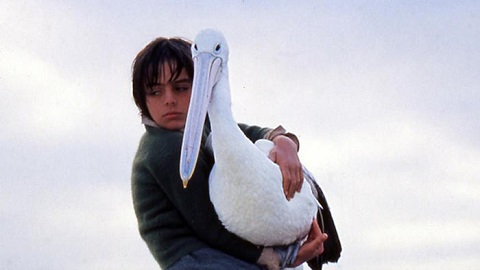
Mike Kingley (Greg Rowe) is a ten-year-old boy who lives in the Coorong, a large reserve in Southern Australia, with his father Tom (Peter Cummins) who eschews the modern world to eke out a living as a fisherman in his little boat. Even the house they live in is a modest affair, barely a shack, really, but Tom has built it sturdy and hardy against the changeable weather in the area. What he will not accept is his son having any influence from the wider world, so when the kid finds a transistor radio on the beach while looking for wood to fuel their boiler, he insists Mike should throw it away immediately, for in his view any element of the outside culture will simply make him want more...
Storm Boy was based on a popular novel, not necessarily a children's novel, mind you, by Colin Thiele, and after its publication in 1963 quickly became regarded as a classic, and a set text for children across Australia, even abroad as well. Sort of the Aussie equivalent of the near-contemporary Dutch book The Wheel on the School, it has gone on to be treasured by many generations, so obviously a movie version was a given, though it took till the following decade before that actually happened. This was likely because the Australian film industry did not take off (pardon the pun) until the nineteen-seventies, so the operation was not in place to create the adaptation.
When it was released in 1976, quite in contrast to the sex and violence-filled Ozploitation flicks that were propping up the nation's industry, it proved a gentle hit to take the younglings too, and down the years many have looked back on either a cinema visit or seeing this on television as a nice, nostalgic memory. That said, despite its reputation as a quiet little film for animal lovers of all ages, a boy and his beast yarn of the sort that have dotted the movie landscape since the medium was devised, there were indications Storm Boy was not going to be like other countries' children's entertainment, leaning as it did into the national character and delivering a particular peril.
Rowe, whose brief career as an actor fizzled out in the eighties, was never less than convincing as the untutored and lonely boy whose best friend ends up being a pelican called Mr Percival, one of three he raises from chicks which were orphaned when hunters semi-illegally shot the birds' parents. This is one of many threads suggesting that Mike's life is not some bed of roses but blighted by what resembled a post-apocalyptic existence where if the landscape was not hauntingly bleak enough then the occasional visitors would have you questioning the validity of humanity's presence there. Every so often, you see, there will be intruders on the land who either shoot the endangered wildlife or get up to simple-minded vandalism which sees the Kingley shack damaged by their buggies crashing into it.
The reason they do not do more damage is because of the other main character, Fingerbone Bill, played by the most visible Aborigine actor of the decade and indeed afterwards, David Gulpilil. Fingerbone was a refugee from his tribe - he tells the boy that he risked his life if he stayed there, so now must exist in exile - and though he should not be on the Coorong by law ("White man's law!" he scorns) he turns ally for Mike and Tom. He also is one of the few people who the child gets to talk to, though a schoolteacher tries and fails to persuade Tom to allow him to learn at her school, making this one of the few nature-based stories to feature a lead character who desperately yearns for civilisation. Not that Mike wants to abandon his life, but he does feel the lack of knowledge in it is hurting his intellect, and with some justification. This did get melodramatic with its trained pelican, the storm, and the hunters leading to a perhaps predictable conclusion, but it was a decent production overall. Remade in 2019. Music by Michael Carlos.