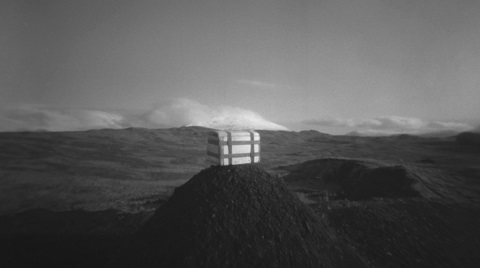
What do you see? The whalebone box is what we see, an artefact made of the remains of a whale that was washed up on the shore of a Scottish island some time ago, apparently meeting its demise in a storm, rather than any whaling ship bringing it to its doom. Part of its skeleton - just a small part - was used in the creation of the container, meaning it the bone is filled with thick oils, and it is bound with lead strips, taken from the lead weights used on fishing nets to catch its fellow denizens of the ocean. But what will happen if you open this box? What is inside? Is it better not to know, and take the object from London all the way back up to Scotland to return it to the sea?
Director Andrew Kotting continued to plough his own furrow with one of his patented mixtures of documentary, fiction, found footage and mysticism born of the land of the British Isles, which according to his work held its own arcane power that humanity barely understood day to day, yet had an effect on them nonetheless. There was as ever a sense that he was drawing on information he had divined himself about existence and was sharing with the audience not to make it plain and explain everything, but to hint and allude to the vastness of life that we tend to accept without question when perhaps we should be trying to get in touch with the mysteries of nature more.
This was a journey film, as much of his efforts were, as Kotting, writer Iain Sinclair (very much on the film's off kilter wavelength) and the cinematographer Anonymous Bosch travelled up the length of the country to the Isle of Harris to ostensibly bury the titular box in the sand. Along the way they stopped off at locations of significance, or they believed were significant anyway, exclusively rural such as graveyards or a ruined castle they rather foolhardily scale despite the warning sign up on what remains of the stairs. If you have seen a film of Kotting's before, you may know what to expect, a patchwork of shots both original and recovered, but not without a sense of humour.
Also appearing was the woman who had become the director's mascot, his daughter Eden who has a condition that impedes her movement and speech (she is helpfully provided with subtitles). She becomes emblematic of the story’s search for meaning in a reality that we only perceive part of, and her dreams of the whale inform how the film presents its material; she appears throughout, whether looking at things through binoculars, or captured sleeping those dreams. If you had followed Kotting since his nineties documentary Gallivant (or before), you may find yourself quite affected that Eden was still a part of her father's output, and his obvious love for her and encouragement of her too remained one of the sweetest elements in all of British indie cinema. She did not join the trio on their excursion, but she was there in spirit.
In addition, there were clips from older documentaries, often amateur, to build the landscape of the picture, along with audio bits and pieces from films like Kiss Me Deadly (the ultimate "What's in the box?" film) or John Carpenter's The Thing, proving the American director was so influential in the twenty-first century that he could show up in the most unlikely places. The cinematography of the journey was shot on an old 16mm camera, lending a vintage quality to the imagery rather than a timeless one, but all part of an experience that was genuinely dreamlike. Yes, you could quibble that more clarity in the intent and delivery could have rendered The Whalebone Box more coherent and accessible, and that Kotting was limiting his audience potential, but really, did anyone want to see him go commercial? Better were his musings on the land and nature that obviously meant so much to him presented with a trickster's eye, and once you adjusted to the rhythm here it was captivatingly eccentric.