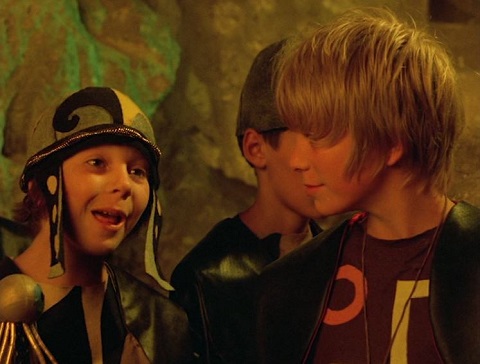
Three friends - two boys and a girl - are holidaying in Malta and enjoying diving in the azure sea off the striking rock formations when one of them notices a strange-looking young boy (Simon Fisher-Turner) swimming nearby. He tries to attract the boy's attention, but to no avail, and an attempt to chase him simply loses sight of him, seemingly for good. But as luck would have it, they do manage to capture him and take him back to their home, where communication proves difficult until they realise he is speaking in a sped-up version of English. With the help of a tape recorder, they work out what he is saying, and he slows down his speech accordingly to tell them a whale of a tale...
The Sea Children, as with many a Children's Film Foundation production, had interesting names in the credits: future soap star Lesley Dunlop, for one, who played the token girl here, and in the role of Kurkal, the underwater kid, Simon Fisher-Turner who would go on to a sporadic acting career, only his heart truly lay with music and he became a recording artiste who also worked on films as a composer, most notably with Derek Jarman; it seems significant he should start the film communicating through a tape recorder, since recording technology would play such a big part of his life to come. On writing duties was Murray Smith, most often seen associating with Pete Walker.
Walker was a British exploitation director extraordinaire, one of horror's real success stories in the nineteen-seventies for the United Kingdom, but this was more a fantasy, if a bizarre one. Children's entertainment can often court jokey queries about whether their creators were all on drugs, as if it's impossible to have an imagination without the help of certain substances, which is just not true, but there was a definite psychedelic air to this effort, which at forty minutes ran a good ten minutes or so shorter than the usual C.F.F. film. It did not look as if they ran out of money, more ran out of story, here featuring a space exploration base that is threatening the existence of Kurkal's undersea home.
Naturally, it is up to the holidaymakers to do something about this, but the plot was not really important as it came across as more an excuse to enjoy the landscape of Malta, offering a helpfully otherworldly appearance to the proceedings. Simple but bright lighting gave this a variety of hues to bask in, making this one of the most colourful of the studio's output next to the likes of The Boy Who Turned Yellow from around the same point in time, indeed it resembled a far out confection from the previous decade of the Swinging Sixties rather than the comparatively drearier seventies. It was all a bit "will this do?" storywise, but visually director David Andrews was patently keen to make a lot out of what cannot have been a massive budget, and carefully chosen images kept The Sea Children as a bauble of improbability which lent on the audience's imagination more than what was actually on the screen.
[This is one of nine films released by The BFI on DVD in the Children's Film Foundation Bumper Box Volume 2.]