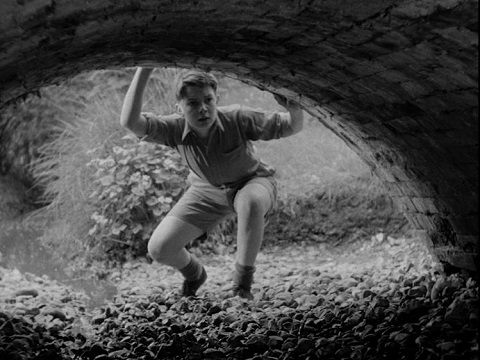
John Adams (Richard Palmer) loves the life of the countryside, but there is room for improvement: no matter how much time he spends at the village pond, feeding the swans and geese and rowing his boat, he wishes he could afford to move into the cottage there with his widowed mother (Hilda Fenemore). If they had enough money to spare, they could be free of having to live and work for Mr Wilson (John Ruddock), a mean gentleman who owns the local bookshop. But one of the tomes references a buried treasure that once owned to John's family, back in the English Civil War days - if he could discern the meaning behind the clues, he could find that elusive treasure...
Treasure at the Mill is generally considered by those who know about such things to be one of the brightest gems in the Children's Film Foundation archive, and certainly one of the best films they produced during the nineteen-fifties. As with most of their output, the plot was simple and easy to follow, but contained a capacity for genuine suspense, and the race against time element this item held was responsible for most of the excitement it generated. Mr Wilson was a typical baddie for these efforts, though he was wholly devoid of humour, and therefore had no redeeming features, he was a meanie through and through, and meant to find the titular treasure before John.
They are both following the same clues, and both have similar levels of ingenuity to conjure with, but John had noble intentions while his would-be nemesis was only going to spend his potentially ill-gotten gains on, I dunno, something really selfish. He must be stopped, and if you knew these short movies you would be eyeing that pond in the first scene as the ideal place for him to fall into, yet director Max Anderson (a documentarian dabbling in fiction) was not about to opt for the obvious and he and his team concocted something different for Wilson, though still water-related. As luck would have it, they begin their search just as a new family move into the mill house they are investigating.
Doesn't sound very lucky, as you wonder if they would claim the treasure as their own, but the Pettit clan, playing themselves and led by a father who is disabled, with one leg he propels himself around on crutches, are thoroughly decent sorts and the three children are not about to thwart justice of a historical variety. Though everyone was obviously dubbed, there was a satisfying sense of, well, niceness about everyone except Wilson, acknowledging that there are people like him who only exist to spread their misery, but most people are happy to help and think well of others beside themselves. Here was a small portrait of how Britons would like to think of their national character, not like the conniving and meanspirited Wilson, more the moral, upstanding and friendly Adams or Pettits. As well as the improving lesson by example, while a limited production otherwise, Treasure at the Mill operated ideally as a juvenile thriller and stood up despite its dated elements decades later. Music by Jack Beaver.
[This is one of nine films released by The BFI on DVD in the Children's Film Foundation Bumper Box Volume 2.]