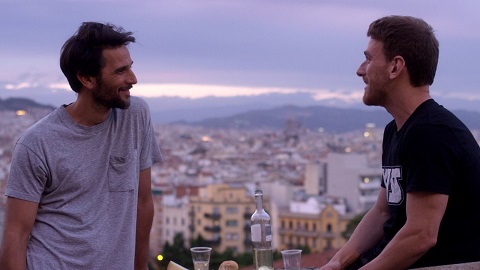
Ocho (Juan Barberini) is living in Barcelona after getting away from a long relationship - he and his boyfriend were together twenty years, and the breakup has left him very much adrift in life, spending his free time wandering the streets, idly taking photos on his phone, or staring mournfully out of his balcony window. To cheer himself up, he opts to visit the beach, and while lying on the sand reading a book he spots a man nearby who walks into the sea for a swim, and not-too-subtly Ocho follows him in. However, there are perhaps mixed signals and when they emerge, the other man leaves without saying anything to him, and he muses over a missed opportunity. But later that day, he spots the man outside his apartment building and calls him up...
End of the Century, or Fin de siglo as it was known in its native Spain, was the first feature from a director of shorts, a familiar pattern for filmmakers to take in the twenty-first century to raise backing for a pet project lasting longer than thirty minutes - this one did not quite make the ninety minute mark, but was not far off. The director was Lucio Castro and on the surface took a gay perspective on relationships that may have put potential viewers (i.e. straight viewers) off, yet there was more to this than might appear even if it regularly became distracted by having its central pair having sex with each other. Nothing hardcore, but a lot more explicit than you would get in many a more mainstream movie, which risked landing the production in something of a ghetto.
There was no guarantee that this would not end up in that state, but it was moving towards a universality that spoke more to middle age, where you began to wonder at the paths not taken and where you would be if you had not, say, hooked up with one person who turned out to be the most significant relationship of your existence, as Ocho finds himself doing. Or rather, finds himself living, as this was a fantasy story of sorts, for just like Billy Pilgrim he becomes unstuck in time, living out his past when he believed he was attempting to break free from it in the film's initial stages. The film brooded over this state of affairs (literal, love affairs) that it threatened to get trapped in a navel-gazing, circular reality where not only the lead character, but also the director and even the audience would be obsessing over themselves.
All triggered by how this unfolds, which was both simple and complicated at the same time. The conceit was that Ocho and his new fancy man, Javi (Ramon Pujol), from the beach were actually Ocho and his original boyfriend, later husband, somehow caught in a time loop so casually constructed that you could be forgiven for not noticing what was going on for quite some time. It was only when you twigged we had gone back in time after a while to the start of Ocho's main relationship that you would understand something was up, and as Castro threw in such experiences as his protagonist's first cottaging encounter that left him paranoid he had caught AIDS you might have said he was trapped up in a nightmare beyond his control. Yet this was no horror flick, as it was more subdued than that, the man on man action aside, inviting reflection and wisdom after the fact instead of having Ocho building a time machine to break the cycle. It was an original approach to a not very original set of circumstances with an anomalous, ruminative, meditative air. Music by Robert Lombardo.