| |
Farewell, The
|
|
| Year: |
2019
|
|
Director: |
Lulu Wang
|
| Stars: |
Shuzen Zhao, Awkwafina, X Mayo, Lu Hong, Lin Hong, Tzi Ma, Diana Lin, Yang Xuejian, Becca Kalil, Jiang Yongbo, Chen Han, Aoi Mizuhara, Li Xiang, Liu Hongli, Zhang Shiming, Zhang Jing, Liu Jinhang, Lin Xi, Shi Lichen, Wang Lin, Yue Xin, Sun Xiaoxiao, Li Do
|
| Genre: |
Drama |
| Rating: |
  7 (from 1 vote) 7 (from 1 vote) |
| Review: |
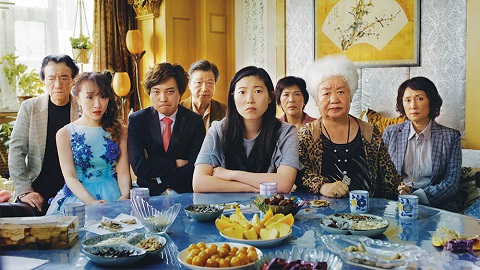
Billi (Awkwafina) is a Chinese American who moved to the United States with her mother and father when she was a little girl, but has stayed in touch with her grandmother, Nai Nai (Shuzen Zhao), all these years, communicating across the world by phone. They will often chat about this and that, and though Billi's Mandarin is not quite as polished as it might have been, they remain close emotionally if not geographically, but today she wonders where her gran is, since there are some odd voices in the background of the call. Nai Nai will not admit it, but she is at the hospital, and is about to take some tests to find out the state of her health - she doesn't know she has cancer...
And nor will she know if her family have anything to do with it, in this understated drama with lightly comedic overtones from writer and director Lulu Wang. She had drawn from personal experiences of her own family, where more or less the same situation arose, to pen the screenplay, though she had had practice by turning it into a radio episode, so with the facts in place and the beats she wished to hit in mind, she ended up with the sleeper hit of 2019. Her elderly star in particular won great acclaim and a clutch of awards, though there were notes of surprise sounded when The Farewell was overlooked for the main awards, despite its popularity, especially in America.
Technically, though most of it was set in China and the larger part of the dialogue was in Mandarin, it was an American film, so perhaps operated better as an introduction to that nation for outsiders than it did for those who were in the know. Whether Chinese families hide terminal cancer diagnoses from their loved ones as a matter of course was not really important, all you needed to be aware of plotwise was that this brood did, and that offered Wang the opportunity to gently muse over the cultural differences and what survives in the immigrant's mentality once they have been separated from their homeland for any length of time: Billi, for instance, considers herself American.
And she is, but her grandmother has provided a genuine connection to the land of her birth that she barely recalls from the time she was at her youngest, and that is valuable, a rock in her life especially when her prospects are dimming as far as pursuing a creative career goes. She would like to be a professional writer, but as we meet her, she has been turned down for a grant and the future does not look too bright as far as her ambitions go. This explains why she wants to visit her for one last time, not merely to pay respects her relative has no idea of her motive, but also to reconnect with something from far back in her past; yes, it was the old "going back to my roots" narrative for the umpteenth time, dressed up in superficially modern trappings, and for some, that meant it was hackneyed and rang somewhat false.
Yet if The Farewell had been overrated to a degree, that was not to say there was nothing to get out of it, though much of it was so specific to Wang's life and her family's lives that it may not be as universal as she had planned or hoped. As in reality, the family rushed a wedding into being to send Nai Nai out on a high, despite the couple only having known one another for three months: you feel a film about that kind of pressure might have made for a more dramatically fruitful premise than following Billi around seeing as how she is at a stage where she is merely marking time rather than moving forward. If anything, she is moving backwards, typical of how one can react when things do not turn out to your advantage: return to your past, like a nostalgic, because there is a certainty about how events transpired back then, purely thanks to you knowing what would happen in that timeframe. Nai Nai was appealingly played to emphasise that, so you could understand why Billi wished to hang onto her. That can hit you either way: you will cry or you won't, essentially. Music by Alex Weston.
|
| Reviewer: |
Graeme Clark
|
| |
|
|


