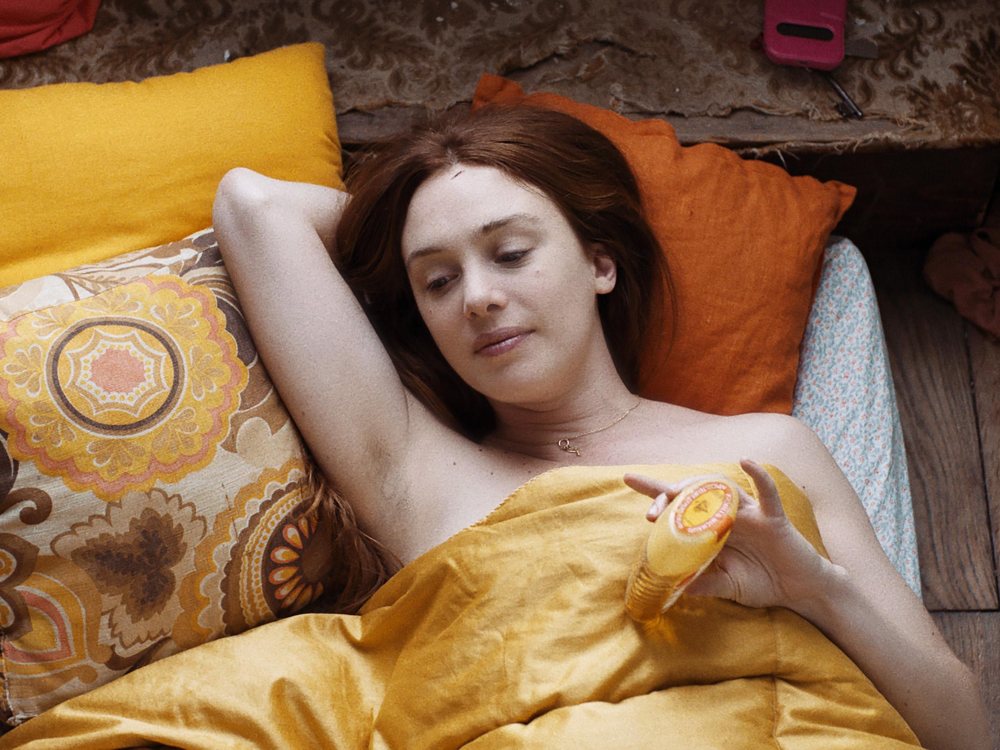
Broke, newly split from a longtime boyfriend, Paula (Laetitia Dosch) is back in Paris after a long absence. Rejected by friends and family alike, including a mother (Nathalie Richard) still angry at her for leaving home, she struggles to adjust, embittered, adrift and alone. Until a chance encounter with Yuki (Léonie Simaga), who mistakes Paula for someone else, lands her the opportunity to grab a new start at life. Which nevertheless does not come easy.
Described by some as an "identity crisis tragicomedy" Jeune Femme - or, to use its original French title: Montparnasse Bienvenüe - won first-time writer-director Léonore Serraille the Camera d'Or at the 2017 Cannes Film Festival. Propelled by a tour de force performance from powerhouse lead actress Laetitia Dosch the film's story of one woman's struggle to find herself in the aftermath of a broken relationship is the sort that would have played very well in the American cinema of the Seventies. Yet arguably resonates just as powerfully with a post-millennial culture grappling with identity issues. While English viewers are by and large less indulgent than the French of self-aware, ennui-afflicted middle class protagonists venting their emotional trauma, one imagines most viewers, regardless of race or gender, can empathize with with a harrowing breakup that leaves one lost and alone, doubting everything about yourself. It is especially painful for Paula who discovers her entire sense of self was wrapped up in a failed relationship.
While certainly far from a laugh riot, Jeune Femme nonetheless wrings no small amount of wry humour from a succession of sad yet revealing episodes in which our heroine is deflated again and again. When we first meet Paula she is pounding and screaming at the door of her ex-boyfriend Joachim (Grégoire Monsaingeon) - whom we learn later was her college professor, which explains a lot. From there Serraille jump-cuts to Paula delivering a neurotic monologue straight to camera in a manner reminiscent of Woody Allen in Annie Hall (1977), only much angrier, prior to the reveal she is haranguing a hapless male nurse. Established as a refreshingly abrasive anti-heroine Paula also comes across as somewhat delusional, mistaken in her belief that she can bullshit her way through life. When in reality she has little in the way of life experience or knowledge, leaving her with only the most meager of ingredients with which to forge a new identity.
What unfolds is a painful tragicomic journey of self-discovery that strips away Paula's facade to construct a more honest and hopefully hardier new incarnation of herself. Which starts ironically with pretending to be somebody else just to share some much longed for human contact with the vivacious and confident Yuki. This in turn opens the door for Paula to find work as a live-in babysitter for a similarly sulky and lonely little girl named Lila (Lila Rose-Gilberti) along with a second job at a lingerie store where she finds a potential love interest in security guard Ousmane (Souleymane Seye Ndiaye). Nevertheless Serraille continues to stress the fragile nature of these tentative new relationships, forever on the point of derailment thanks to Paula's self-destructive or at times unintentionally feckless nature. Just when she seems to have gained some stability life throws Paula one last major curveball, leading to a final confrontation with Joachim and one jarring scene that threatens to pull the film into much darker territory. Although Paula's journey does reach some kind of conclusion the abrupt finale leaves things open-ended to a potentially frustrating degree. Whether Serraille and co-scenarists Clémence Carré and Bastien Daret were uncertain how to resolve their story or else reluctant to slap on a contrived wrap-up remains unclear. Either way Jeune Femme finishes as it starts, with bracing honesty.