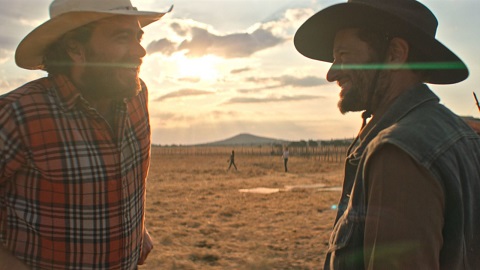
On this Mexican ranch, all seems to be going well, as the young children and teenagers of the families who operate it play in the lake there, which has become muddy and shallow thanks to lack of rain, but offers an area to fling mud around and throw each other into what waters there are. It is a cattle ranch owned by Juan (Carlos Reygedas) and Ester (Natalia López), a husband and wife who have two children themselves, but appear to be content in their lives running the farm and regularly enjoying moments of intimacy. However, these intimate moments are not always with one another: they have an open relationship, which is fine as long as they tell their partner all about their affairs...
Writer, director and star Reygedas had become a cult figure among certain cineastes for making films not quite like anyone else, often spiralling off on weird tangents but always exquisitely photographed and with an off-kilter take on humanity that was refreshing to those who could keep up with him. For Our Time, or Nuestro tiempo as it was originally called, you could tell it was one of his works if you knew his previous efforts, yet he had made a conscious try at broadening his available audience by cutting out the surrealism, all the better to concentrate on the couple at the heart of the drama. That said, there were few mainstream viewers who would stay the course.
This was just shy of three hours of domestic trauma, nothing so offputting as actual abuse or deliberate evil, more a sense that the pair were unable to perceive where they were going wrong in this relationship, and further than that, we thought we could until we wondered if they were in the same position as we watching were. It seemed tailor made to start arguments, as if to ask in increasingly hysterical fashion, "You thought you were happy?! You believe that marriage is a normal state of things?! Or any kind of romantic relationship?! Well, think on this, sucker!" It was coming from a place of extreme disillusionment, and what made it more uncomfortable was a truth.
That truth being Reygadas had recklessly based the entire film on his own marriage, though how much was exaggerated for dramatic effect, or for that matter comic effect, was something only he and his wife knew. He and his wife López playing the leads here, and corralling their two kids to play the offspring of their characters as reality and fiction were blurred and the overall impression was of a couple wondering how they could have been so stupid, to the extent that they may he demanding an answer to that question in relation to making this movie as much as they were placing their supposed bond under the microscope. No, the director's outlandish, otherworldly excesses were not present here, yet there remained an unsettling style that did not really need those flourishes when the emotional gymnastics were enough.
Mind you, Reygadas still liked to experiment to an extent, so demonstrating the versatility of his camera equipment he got up to such shenanigans as roaming around a huge concert hall as a timpani concerto plays, or placing the lens beside a car tyre as it is driven (and hits a puddle, thus making the exercise pointless as the image is lost in more mud), or most audaciously offering a lengthy view of a city at night that gradually reveals itself to be taken from the underside of a landing passenger jet. All the while, this grand perspective contrasts with the big, yet petty and clueless, feelings of the central trio as Juan cannot stand by and let Ester be taken from him by hippyish horse trainer Phil (Phil Burgers), not understanding that standing by would be exactly what he needed to do for her to return. This could all have been angst-ridden and operatic but grows so absurd that even a friend dying of cancer becomes ridiculous when Juan is added to the mix, prompting uneasy laughter. As a telling off of humanity and the film's creators, it was quite something, weirdly oblique in some ways, groaning metaphorically in others, but purposefully uncomfortable in effect.