Pu Songling (Jackie Chan), a happy-go-lucky scholar, author and mystical adventurer in Qing dynasty China, regales children at a local town with tall tales of his demon-busting exploits, aided by his cute otherworldly sidekicks: Breezy, a pink-haired floaty mushroom fairy, Gassy the flatulent little green vampire and Handsy who has a house for a head and multiple elastic limbs. Upset the spooky stories will scare their young 'uns a group of concerned mothers confront Pu. Only Pu promptly has Breezy use her Men in Black-style mind-wipe powers and flogs them his latest short stories. Assigned to arrest Pu, callow police constable Yan Fei (Austin Lin) stumbles upon this so-called fraud entrapping the Hog Goblin (Shan Qiao) as his next demonic acquisition. Yan Fei eventually cajoles a reluctant Pu into taking him as his apprentice. Together they come to the aid of Ning Caichen (Ethan Juan), a troubled rival demon-hunter trying to stop Nie Xiao-Qian (gorgeous Zhong Chuxi), a bewitchingly lovely lady ghost in red, from stealing the souls of local maidens for her ancient mistress. Only Pu Songling discovers their relationship is more complicated than it first seems.
Back in the Eighties and early Nineties when Hong Kong fantasy blockbusters were in their heyday, Jackie Chan declined numerous offers to appear in such films because he felt the genre over-relied on wire-work and special effects. Instead of his own distinctive brand of hard knocks kung fu. Yet in interviews as far back as the mid-Nineties Jackie admitted that, having fought every form of human opponent on screen, it might be cool to fight something inhuman. After tentative steps in effects-enhanced Hollywood fare like The Forbidden Kingdom (2008), Jackie has of late graced several Asian fantasy blockbusters: Bleeding Steel (2017), Russian co-production Vij 2: Journey to China (2019) and now The Knight of Shadows: Between Yin and Yang, his most ambitious and engaging genre outing yet.
The film delivers a fantastical take on the exploits of Pu Songling, the real-life scholar and author behind 'Strange Tales from a Chinese Studio.' This landmark anthology of supernatural stories sired a cottage industry of cinematic adaptations in Hong Kong from Li Han-hsiang's operatic Enchanted Shadow (1960) and King Hu's multilayered epic A Touch of Zen (1969) to Tsui Hark and Ching Siu-Tung's genre-redefining A Chinese Ghost Story (1987) and the flood of imitators that followed. As well as more recent digitally-enhanced blockbusters as Painted Skin (2008) and Mural (2011). Re-casting the famed author as an actual ghost-buster with wizard powers interacting with his own literary creations (including Nie Xiao-Qian, the iconic character whose like named short story inspired all those lovelorn lady ghosts Joey Wong and others portrayed in every Chinese supernatural romance) is an inspired move. Somewhat in the vein of Goosebumps (2016) or what Terry Gilliam tried to do with The Brothers Grimm (2004). Stylistically though Knight of Shadows is akin to Japan's recent revived 'yokai' films (e.g. Sakuya, Slayer of Demons (2000), The Great Yokai War (2005), Gegege No Kitaro (2007)); an overdue attempt to tap Chinese mythology for children's entertainment.
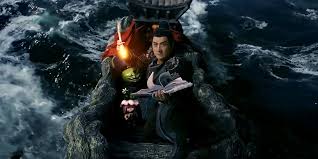
Very much a children's film, in the vein of China's record-grossing Monster Hunt (2015), Knight of Shadows predictably alienated Jackie's hardcore action fans. Yet as sparkling state-of-the-art Asian family entertainment it delivers. Visually stunning, the film has a storybook feel. Director Yan Jia, who sometimes goes by the alias Vash and previously delivered sci-fi disaster movie Bugs (2014), melds colourful live-action sets and costumes with whimsical, purposefully cartoonish (though not unappealing) computer graphics. Meanwhile the cast, with two notable exceptions, give pantomime performances befitting the rollicking cartoon tone. Not least our leading man. As the merry Pu Songling, Jackie Chan waves his spell-casting magic brush, sings lovably goofy songs and cavorts with all manner of charming CGI critters. What he does not do is perform much in the way of martial arts, having noticeably slowed down with age. Certainly, compared with HK cinema in its prime, the editing of the action sequences here is curiously lethargic. Nonetheless Yan Jia serves up some inspired fantasy sequences: e.g. the ocean-bound prologue where Pu and his pals subdue gigantic fish god; a battle with Zhong Chuxi's shapeshifting vaporous ghost that sees Pu Songling's top half trapped inside a mirror while his legs run amuck; and the kaleidoscopic climax set amidst the spirit realm inside Pu's magical book. Yan Jia's background in digital animation is especially apparent in the film's numerous painterly 2D animated episodes. Notably a dazzling flashback origin story for Ning Caichen and Nie Xiao-Qian rendered in a lush watercolour style.
Interweaving storylines from multiple Pu Songling tales, Knight of Shadows more accurately reflects the tone of classic HK ghost stories with the right mix of knockabout comedy, supernatural mayhem and lyrical romance than the po-faced 2011 mainland Chinese-censored remake of A Chinese Ghost Story. Zhong Chuxi and Ethan Juan give especially strong performances as the star-crossed Nie Xiao-Qian and Ning Caichen, bringing a crucial emotional weight to the story and an ingenious plot twist that ties it to the original Chinese Ghost Story. Which makes the third act that more involving as hitherto sympathetic characters go to dark lengths in the name of love and unwittingly unleash all manner of evils on the mortal world. Released on Hong Kong and Chinese screens as part of the New Year season the end credits feature cast members both real and animated wishing the audience a happy new year while Jackie and likable co-star Austin Lin perform the theme song.