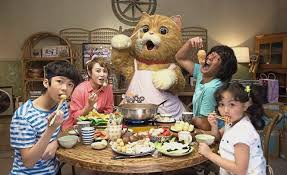
In a distant corner of the universe lies the cat-shaped planet Meow populated by super-intelligent, super-powered felines. For a thousand years the King of Meow has been sending messengers to the planet Earth, laying the groundwork for an invasion. Now that time has come. So the King sends Pudding: bravest, mightiest warrior of Meow, on a mission to Earth to rally their sleeper agents. Unfortunately a freak thunderstorm has Pudding's spaceship crash in Hong Kong whereupon he also loses the Meowian Secret Weapon. Stranded and desperate, he adopts a hasty disguise as Xi Xili: an over-sized (indeed, human-sized!) ginger house-cat whom local dimwit Go-lee Wu (Louis Koo), a failed footballer turned struggling entrepreneur, mistakes for the pet his boss hired him to watch over. Before the bewildered cat from outer space knows what is happening, Go-lee takes it home to meet his wacky family: feisty wife Pearl (Mai Li), a model and actress struggling for work because she is often inexplicably mistaken for Vin Diesel in drag (!), older son Yoho (Andy Huang) who dreams of becoming a filmmaker and younger daughter Yoyo (Jessica Liu Chu-Tian) who suffers from a congenital skeletal anomaly in her right leg. Delighted to finally own a cat, Yoyo bestows him with his new name and showers him with love, leaving Xi Xili mortified, plotting to eliminate the family and set the invasion in motion.
At first sight of its trailer few had high hopes for Meow which seemed like the Hong Kong version of such charmless CGI-swamped family fare as Garfield (2004), Marmaduke (2010) or the dreaded Alvin and the Chipmunks franchise. A children's sci-fi comedy about an enormous talking alien cat certainly marks a bizarre change of pace for action filmmaker Benny Chan (the man behind, among others: Who Am I? (1998), Gen-X Cops (1999) and Shaolin (2011)) here in his sixth collaboration with seasoned actor Louis Koo. Yet against all odds and thanks to a barrage of inspired gags, groundbreaking visual effects (at least, for HK films), engaging characters and a heart as big, warm and furry as the ginger furball that waddles across the screen, Meow stands as perhaps the closest thing to Paddington (2014) the Chinese film industry will likely produce. Cat-lovers alone will likely savour scenes such as Xi Xili's encounter with the lazy local cats whom he discovers have happily relinquished their invasion plans since human hosts already tend to their every need.
The first act goes to an amusingly dark place as Xi Xili grabs a kitchen knife and tries to freakin' murder the Wu family. Only to be undone by their zany sleepwalking antics and Yoyo's inherent kindness and lovability. The turning point comes in a disarmingly emotional scene during a robbery wherein the Wu family endanger themselves to keep Xi Xili safe from harm. Thereafter co-writers Chan Hing-Kar - seasoned comedy director behind La Brassiere (2001) and All's Well That Ends Well (2011) - and Ho Miu-Kei, who co-wrote Stephen Chow Sing-Chi's blockbusting fantasy The Mermaid (2016), refashion this into a story about Xi Xili learning the beauty of family as the Wu's unite in the face of escalating adversity. The space cat becomes involved in Go-lee and Pearl's marital and financial difficulties, fueled first by the nice-but-dim husband's propensity for falling for every scam artist he encounters then a wealthy former schoolmate (Louis Yuen) out to woo his spouse. Yet for all their failings the Wu clan still band around their most vulnerable member, young Yoyo while she is beset by bullying, self-esteem issues and medical bills that seem insurmountable.
Exuberant performances from an excellent ensemble cast pitch the film towards live-action cartoon bolstered by computer graphics that rank among the most accomplished and eye-catching in Asian cinema. Particularly in the opening sequence set on Meow while Xi Xili himself is a remarkably lifelike creation. Yet the film would be little more than a series of crowd-pleasing skits (later, a plot twist segues into an all too plausible satire of the Hong Kong entertainment industry with spot-on parodies of inane HK ads, tabloid headlines and movies) were it not able to pull off some admittedly sentimental yet earnest and surprisingly weighty drama.