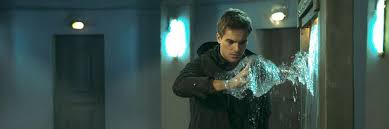
A young resident of Moscow, Kirill Maximov (Nikita Volkov), wakes up in the back of a police van with a bloody nose. Just twenty-four hours earlier he was a newly successful designer of computer games, albeit brokenhearted after being rejected by Anna (Olga Borvskaya), the girl he loves. But then one day Kirill finds he has been erased from the memories of everyone he knew. His friends, neighbours, co-workers, even his parents no longer recognize him. On top of that the state has no record he ever existed. When Kirill confronts Renata (Severija Janušauskaite), the coolly sinister blonde woman who now occupies his apartment, she inexplicably yet quite calmly forces him to stab her to death! Immediately subdued by horrified neighbours, Kirill awakens in police custody. Only the cops strangely let him go. Text messages lead Kirill to a secret location where he is greeted by Renata, unfathomably alive and well. She duly informs Kirill he now resides in an alternate reality and that up till now his life has been a rough draft in preparation for his true destiny: as a super-powered guardian of doorways to multiple parallel worlds.
Joining the head-scratching ranks of Inhabited Island (2008), Branded (2012) and Attraction (2017), Chernovik (released in English as: A Rough Draft) slots into the post-Timur Bekmambetov wave of Russian high-concept sci-fi blockbusters. Films with big budgets, bombastic visuals and incomprehensible plots. Getting off to an instantly confusing start the film thereafter barely gels into a coherent narrative, shuffling scenes, plot threads, ideas and characters into an unfathomable mess. Part sitcom, part sub-Kafka-esque allegory, part Matrix-style high-octane sci-fi thriller. Adapted from an evidently acclaimed novel by Night Watch (2004) author Sergei Lukyanenko (whose fans were not pleased with the results) A Rough Draft starts with a classic paranoid sci-fi idea. One that served the basis of many a Twilight Zone episode: your life is no longer your own. Poor, luckless Kirill becomes an non-entity overnight, forgotten and shunned by those he loved. It is theme especially pertinent in Russia, a country with a history of making citizens disappear.
Yet the film, somehow both excruciatingly slow and rushing its way through some heady ideas, abandons this plot thread to head down a more fanciful direction. In a succession of whimsical scenes, halfway between Howl's Moving Castle (2004) and Doctor Strange (2016), Kirill is inducted into a secret society of immortal super-beings led by sexy aristocrat Rose White (Yulia Peresild), whom he first meets submerged in a bathtub bleeding from a gaping neck wound (don't worry, she's fine - though don't go expecting a rational explanation for this intro), develops mystical martial arts skills in battle with gun-toting robots disguised as giant matryoshka dolls, and becomes custodian of a house with doors that open to multiple worlds (a steampunk Imperial Russia, a post-apocalyptic tropical resort world, a dystopian Gulag world, and a highly advanced utopia called Arkhan).
All of which would be a lot to take in for most people, it certainly is for the viewer, and yet Kirill is curiously nonplussed by the sheer mind-bending strangeness of what unfolds. Probably because the film abruptly shunts all this heady fantasy stuff into the background to focus on Kirill attempting to rekindle a romance with an Anna from another reality who becomes one of his dimension exploring clients. Along with her bureaucrat boyfriend Anton (Yevgeny Tsyganov) who has his own vaguely defined subplot about aiding an attempt to take over the multiverse. Alas, this new Anna proves as hesitant about hooking up with Kirill. Especially once she learns immortal super-beings cannot have children. The film tries to make a lot out of a romance that flounders because the protagonists are so deathly dull. No-one in this film behaves like a sane or rational human being, treating outlandish events as either commonplace or ranting like eccentric refugees from a Lewis Carroll story.
Sergey Moritsky, in a disappointing follow-up to Battle for Sevastopol (2015), his biographical war epic about female WWII sniper Lyudmila Pavlichenko (a big box-office hit in Russia), makes a right ham-fisted mess of the source material despite dealing with interesting ideas. Most notably the conceit that alternate realities, including our own Earth, serve as 'rough drafts' for a more advanced civilization: pin-pointing failures and pit-falls to be avoided in their timeline. Moritsky stages a lot of surrealistic visuals (robots, steampunk airships, gravity-defying action scenes) that while eye-catching do nothing to either enhance or clarify the frustratingly obtuse story. Even the would-be surprise twist revealing the identity of the Curator behind the multiverse proves arbitrary and inconsequential. Out of nowhere the last fifteen minutes suddenly turn into a Marvel movie as Kirill fights more robo-dolls and his fellow 'Functionals' in order to save Anna. It ends on a cliffhanger set-up for a sequel unlikely to wet the appetites of any but the most masochistic.