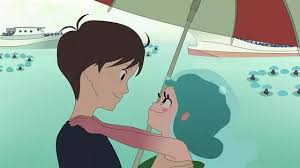
Kai (voiced by Shota Shimota), an introverted teen who left Tokyo to live with his divorced dad in the ailing fishing town of Hinashi, is mortified when school friends Yuho (Minako Kotobuki) and Kunio (Soma Saito) recognize his musical noodlings in a video posted online. They invite him to join their band. Lacking confidence in his own talent and mindful his father (Shinichi Shinohara) would rather he focused on those all-important high school exams, Kai is not especially keen. Yet as the band rehearse at an abandoned amusement park called Mermaid Island, their raucous feel-good rock inadvertently summons Lu (Kanon Tani), a sprightly little mermaid who starts to dance and sing with infectious glee. Inspired by their magical encounter, Kai recruits Lu as their new lead singer. Together their music has a galvanizing effect upon the citizens of Hinashi. However, as the band grow increasingly popular, Kai discovers the town has a troubling history with mermaids.
Masaaki Yuasa is among the most vital creative talents working in Japanese animation today. In the years since his astonishing debut with the near-indescribable Mind Game (2004), Yuasa has consistently forged an idiosyncratic path, steering a medium at risk of growing stale into deliriously inventive, headily philosophical waters. Following a special guest directing gig on cult American children's show Adventure Time, Yuasa returned to the big screen with Lu Over the Wall: his most commercial yet conversely, and hearteningly, personal venture yet. Taking a step forward from the breakneck surrealism that characterized much of Yuasa's early work the film exhibits a much clearer focus on narrative and character development. Scenes of domestic strife between Kai, his father (who as drawn seems barely older than he is) and suspicious, embittered grandfather (Akira Emoto) unfold in near-static, almost Yasujiro Ozu-like fashion. Yet whenever the band starts to play Yuasa's kaliedoscopic imagination takes flight.
The visuals pulsate and metamorphose, mixing formats and switching styles in a manner reflecting that indefinable exuberant feeling instilled only by the best, most joyous bubblegum pop. Mirrored in the glorious water-manipulation powers and frankly hilarious dance moves of the impish, smiley-faced Lu who bears a passing resemblance to Ponyo (2008), titular heroine of Hayao Miyazaki's not wholly dissimilar mermaid anime. Except Yuasa fashions Lu into a character beguilingly kawaii and goofy, but also otherworldly in a way that is just that little bit unnerving. After all Ponyo never sprouted enormous razor fangs to vampire bite puppies turning them into adorable mer-dogs. Taking a slice-of-life approach to the paranormal reminiscent of vintage Studio Ghibli, characters react to the strangest events in amusingly matter-of-fact manner, be that discarded fish bones marching back to life or the memorable arrival of a giant shark man in a business suit visiting the local tourist board.
Energized by the DIV spirit of its young protagonists' garage rock, the film unfolds as an allegory about the perils of instant fame, compromising artistic integrity and how fear sometimes drives ordinary decent folk to do appalling things. A plot twist steers the story in a darker direction reminding us that mermaids traditionally have a more sinister image in Japan than in the west. As reflected in the gory live-action nightmares of Mermaid in a Manhole (1991) and Rumiko Takahashi's anime Mermaid's Forest (1991) or J-pop star turned filmmaker Tatsuya Ishii's solemnly sensual Acri (1996). Yet Yuasa also includes unexpected nods to E.T. The Extra-Terrestrial (1982) and Roman Holiday (1953) and ultimately fashions the film into a love story of how creativity in all its forms can inspire people to overcome hardship and prejudice. Though posters focus on Kai and Lu, the film is truly ensemble piece filled with flawed but likable characters learning to outgrow their failings and band together. After all, as one character remarks: "If mermaids exist, anything is possible."