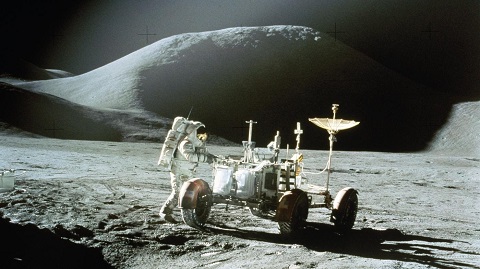
Between 1968 and 1972, NASA sent nine missions into space with the purpose of exploring the Moon, as President John F. Kennedy had promised the world would happen within his lifetime. Sadly, he was assassinated before the first Moon mission was undertaken, but his promise was always in the mind of those scientists and technicians who were working day and night to get the project into shape, and though he did not live to see it fulfilled, those who remembered him noted not simply his hopes, but the hopes of a nation, indeed the whole world, were satisfied by this monumental achievement. This documentary pieces together the footage of the missions...
Director Al Reinert has access to countless feet of film taken by NASA's onboard cameras, all placed around the hardware to document what was going right - and what may go wrong. It's mentioned at the end, but there were those who lost their lives in the space program, both American and Russian, and that was a sober reminder that no matter how much fun some of this looked, and how awe-inspiring the rest was, it was still a highly dangerous endeavour that could have ended in disaster. We are possibly more aware of this thanks to another film Reinert was involved with, Apollo 13, which highlighted the perils of space travel; two space shuttle disasters too.
What For All Mankind turned out to be was essentially an eighty minute montage of the clips taken from various missions, accompanied by the sage words of the astronauts who had taken part in them, and a selection of music tracks for atmosphere (as after all, there is no sound in space). Much of that music was drawn from Brian Eno's ambient works, and that was a very good fit, seemingly appropriately epic while oddly intimate when matched with the visual splendour of our nearest satellite and our own homeworld spinning in space. The footage alone, particularly when in space, was fascinating, and of course the eventual landing on the Moon delivered a collection of gems.
However, Reinert was not without his critics, mostly in his choices for assembling what NASA gave access to. He played fast and loose with what part of which mission went where, even to the extent of re-editing Kennedy's famous speech, as if it was not important-sounding enough for this director's liking (JFK actually dedicated the program "for all people", which does seem more inclusive in these days of poring over every gender-based noun and pronoun). Also, purists were irked when scenes not from the Moon escapades were included, to make it appear that a Gemini spacewalk had been part of the Apollo flights, for instance, and parts that genuinely were from the Moon exploration were mashed together to create more of an impression of what it was like to be there, rather than something more chronologically authentic.
You may regard these as quibbles, you may have wished for a little less creativity in the editing, but what you could not argue with was the footage would be evergreen as a depiction of possibly the greatest success of the twenty-first century, and seeing as how that century was afflicted with some of the worst excesses of humanity, we needed something like this to redeem ourselves. Watching the Earth passively but weightily hanging in the void was impressive enough, but the shots of the moonscape were as gripping now as they had been back then, when the world was looking on, riveted. Perhaps the repetition of these scenes in various media through the decades may have robbed them of some power, yet witnessing them gathered together in one place brought home the vastness of the task that the missions had been to bring them to us, from the craters gliding by under the lunar lander, to the lunar rover speeding across the surface, even to finding out what the first words spoken by the second man on the Moon were. Alas, Neil Armstrong, the first, declined to be interviewed, but the anecdotes, curiously anonymous here, helped build a vivid account.
[The Criterion Collection release For All Mankind on Blu-ray with these director-approved features:
* New, restored high-definition digital transfer, supervised and approved by producer-director Al Reinert, with 5.1 surround DTS-HD Master Audio soundtrack)
* Audio commentary featuring Reinert and Apollo 17 commander Eugene A. Cernan, the last man to set foot on the moon
* An Accidental Gift: The Making of "For All Mankind," a new documentary featuring interviews with Reinert, Apollo 12 and Skylab astronaut Alan Bean, and NASA archive specialists Don Pickard, Mike Gentry, Morris Williams, and Chuck Welch
* On Camera, a collection of excerpted on-screen interviews with fifteen of the Apollo astronauts
* New video programme about Bean's artwork, accompanied by a gallery of his paintings
* NASA audio highlights and lift-off footage
* Optional on-screen identification of astronauts and mission control specialists
* PLUS: A booklet featuring essays by film critic Terrence Rafferty and Reinert.]