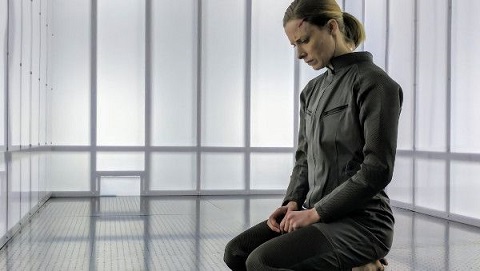
This is The United Kingdom - soon, where a civil war is raging as a result of violent opposition to a weak, yet oppressive government, leaving a power vacuum that terrorists could step in to fill. As the battles wage outside, in this room a woman (Shauna Macdonald) wakes up and finds there are no doors or windows to be seen, it is pure white aside from the bars that support the roof. Basically, there is no way out and she is at the mercy of whoever has placed her inside, who turns out to be the owner of the distorted voice who begins to interrogate her. She insists she was merely the admin girl in this facility and cannot help, but the voice is insistent too... very insistent.
This was one of those science fiction dramas that set out to warn you in its premise that the authorities wanted to kill you, then proceeded to show you how over the course of the running time. This was somewhat different in that it also illustrated how the rebel forces probably wanted to kill you as well, so you could regard a political balance to the message, or more likely, a sense of confusion born of writer and director Paul Raschid not wishing to tip too far in one direction or the other. What was clear was that he was against oppression in all its forms, and illustrated it could be used in more than one way, by more than one political movement, to achieve its goals.
White Chamber was also one of those science fiction movies which made the most of its limited sets: yes, we were in Cube territory once again, where one set was repurposed again and again, though this time it was supposed to be a single location from beginning to end. We spend the first twenty minutes or so in that titular chamber watching the woman subjected to various tortures, for another unwritten rule was that if stuck in a confined space, any character therein would be suffering some kind of ordeal, so this was as much a horror flick as it was a sci-fi effort, again, a very recognisable trope from the world of low budget genre movies dabbling in more than one technique.
Macdonald had proven her worth in the portrayal of brittle but driven characters before, so this was not really anything new for her as far as performance went, yet she had been hired for a reason, and she gave this her all, especially after the twist happened early and we flashed back five days to find out how she got where she was and what the scientists who devised the chamber had been up to. True, it was mad scientist territory once more, with the cliché murderous boffins devising a new drug for military use, but once you scratched the surface not much that Bela Lugosi or Lionel Atwill had not been indulging in back in the nineteen-thirties. What was different were the pretensions to social commentary, which here served as a spine for the plot even if it played out in practice as rather vague.
There was a small cast at work here, but they were all well applied, in particular Oded Fehr as a freedom fighter/terrorist who has been in the torture chamber and experimented on like a lab rat. The point that remote observation, here in a laboratory, but just as easily applied to an audience watching on television or online, dehumanised both the observer and the observed was a valid one, especially in a world where citizens were increasingly interacting with one another through screens, but again, the genre had been telling us stuff like this since the sixties, before that even, so this was not as fresh as it liked to think. The tone was clinical, a shade smug in places, but it did score its points on how politics can divide just as easily as it can unite with needling precision, and by the conclusion you may not have been one hundred percent sure who Raschid was siding with in light of how both used the worst possible methods to succeed in a probably unwinnable conflict. Not a barrel of laughs, but it did have a brain in its head. Music by John Harle.