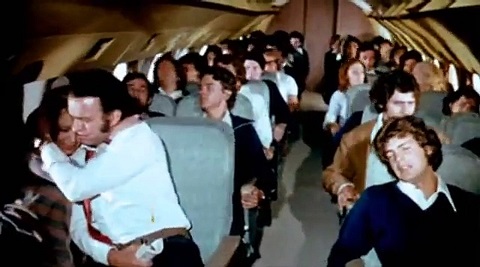
The year is 1972 and this Uruguayan university rugby team are boarding an aeroplane to take them across the Andes mountain range to Chile, where they are to play an important match. Spirits are high when in the departure lounge and continue to be so on the aircraft itself, but what the passengers do not know is that the journey they are about to undertake is a difficult one, fraught with danger when the wind across the peaks can make for perilous conditions, not to mention the blizzards that can rise up without warning. However, this hits home when the plane is the victim of all those elements, and it crashes into the side of a mountain, stranding the survivors...
In 1972 a Uruguayan rugby team did indeed fall victim to a plane crash, and there was a book written about it that Mexican father and son filmmakers René Cardona and René Cardona Jr joined forces to recreate for the movies. They had become mildly notorious for their exploitation efforts, but whatever you thought about their subject matter or indeed the quality of their output, they were successful and Survive! was about as popular as they ever got, mainly thanks to an English language edit of it masterminded by Robert Stigwood and Allan Carr, two men never far away from a music cash-in that, in turn, made them a lot of money too. Just add a blanket marketing campaign.
Survive! showed up in theatres across the globe, since it was so cheap to produce they could get away with releasing it far and wide, and though little-talked about now, was a huge hit in comparison with similar trashy items. They would try the same trick with the Jim Jones story in Guyana: Cult of the Damned and set the box office tills a-ringing once again at the end of the seventies, but if you had ever heard of the Cardonas, it would either be this or their Santa Claus festive nightmare that would be the reason. Not that this effort was praised for its sensitivity and historical accuracy, as save for the crash and the eventual rescue of some, it was a loose adaptation in its American re-edit.
But let's get to why anyone was familiar with the basic narrative: cannibalism. Those rugby players had had to resort to eating the dead passengers to, well, survive when things grew utterly desperate, and this fact has landed the case with a prurient interest that has passed into folklore of a sort (there's an episode of The Hammer House of Horror TV series that is obviously inspired by it, for instance). When Frank Marshall made his own version with Alive in the nineties, he was so respectful that in his endeavours to create a testament to the human spirit, the consumption of human flesh was alluded to as tastefully as possible, with the result that it was more in the background of the cast trekking across the Andes to reach safety. The Cardonas were not so squeamish.
Therefore when watching Survive! you find yourself getting increasingly restless to get to the business most would not be happy to admit they were most interested in: when do the victims of this tragedy start eating the dead? Not helping in this uncomfortable eagerness was that the whole movie was presented with as few bells and whistles as possible, to keep the costs down, so in the main you were watching those survivors bickering and keeping warm, as they begin to pass away one by one, which may be what happened in real life, but for a disaster movie there were far better, fictional examples. Nevertheless, the stripping of the corpses for meat was appropriately gruesome, though that was more by implication as we didn't see that much of it, what we did see still yucky, mind you. Once that was over, the plot hurried at an unseemly pace to the end where the inevitable happened and a bittersweet conclusion was reached, the only real part of the movie that was effective emotionally. A strange, but not compelling, mixture of trash and tribute. Music by Gerald Fried (in the American version).