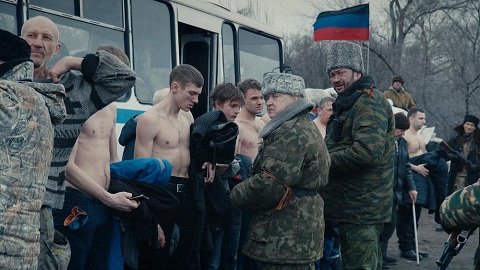
The place is Ukraine, where there has been a conflict raging in one part of the country for the soul of the entire part of the region, the issue being the Russian separatists who wish it to rejoin the Russian Federation, and have the might of that nation's army behind them, leaving the ordinary Ukrainians lost in the melee. But there are so many complications that it is difficult to work out precisely what is happening, never mind who is in charge, and the power of the media is corrupted when actors and extras are hired to play out fake news reports such as this one, where a bombing of a bus has been entirely staged for Russian-friendly news sources to broadcast on their bulletins and the internet...
If ever there was a film that had you coming away less certain of news reports of war, in Ukraine or anywhere else, it was director Sergey Loznitsa's Donbass, named after the city where some of it unfolded, and drawn from recreations of said news footage and clips from amateur sources uploaded online, often with such accuracy that the restaging process itself was a mystery when he could simply have strung together some bits and pieces he had harvested from the internet and saved himself a lot of money and trouble. Yet it was the art of recreation that was perhaps the point here, not recreation as in play or sport, but refashioning these sources in search of the truth.
That Loznitsa failed to clear anything up very much was not a failing of his endeavours, more an accurate representation of the chaos he was trying to capture. However, it was all too easy to lose your bearings when he flitted from one sequence to another, regardless of any viewer trying to discern a narrative in this parade of depressing examples of just how awful people can be to each other without even being very sure of why. Ask one of these folks why they exploit their fellow countrymen and woman, or for instance in one scene, turn a bus stop into a near-lynch mob, and they would only be able to concoct some flimsy excuses around a sense of patriotism or pride.
Even when they are enjoying themselves, they look appalling: take the wedding where the thread of a society on the verge of total collapse is summed up by raucous celebration so obnoxious that the celebrants come across as one step away from utterly feral. There were more intimate scenes too, every one dripping with menace: take the local businessman called in to a government office to demand he signs over his car to them, without giving him any reason except for some vague threats about resisting fascism and him needing to play his part, never mind that he needs the vehicle to pick up his daughter from school, quite apart from it being essential for his work. The more reluctant he grows, the more insistent the official is, eventually telling him he will sign over the car or else he will send some soldiers round to "pick up" the child.
Donbass was billed as a comedy, and maybe if you know the Ukrainian sense of humour you will find it funny, but more often than not it's disturbing to witness its characters (for want of a better word) behaving with such rampant self-interest and a bullying belligerence that even the most underdog of them can turn to when they get the chance to victimise someone they regard as lower down the social ladder than they are. But there is a war going on: though internationally there is reluctance to call it that in those blunt terms, how would an apologist explain the bombs going off, and not the ones staged for the fake news cameras, either? There was a steely purpose in this that often felt as if you were being taught a lesson had you ever been complacent about a news report from a flashpoint, and that did not necessarily make for an enjoyable watch - it certainly did not generate many laughs despite the promises of its category. As a sickened examination of human nature, it did contain a chaotic power.