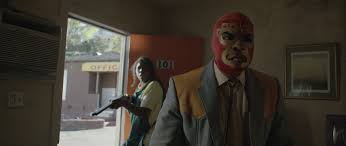
Amidst the seedy underbelly of L.A. the lives of several lowly desperate folk intersect through their dealings with Teddy 'Bear' Haynes (Mark Burnham), a murderous crime boss who abducts illegal immigrants as part of a sex slave and organ-harvesting ring. Serving as Teddy's hired muscle is El Monstruo (Ricardo Adam Zarate), a Mexican luchadore or masked wrestler prone to blackouts and schizophrenic rage fits. Between grappling with conflicted feelings about this job and a desire to stay true to the legacy of his heroic father, El Monstruo struggles to keep his pregnant teen wife Kaylee (Santana Dempsey) from resuming her drug habit. Meanwhile motel clerk Crystal (Nicki Micheaux) reaches out in desperation to Teddy for a kidney to save her ailing husband. Tasked by Teddy to kidnap the unsuspecting donor, accountant turned comically-inept criminal Keith (Shaye Ogbonna) reaches out to his buddy Randy (Jon Oswald), fresh out of jail and sporting a facial tattoo of swastika hilariously at odds with his easygoing persona. A gruesome yet darkly comedic chain of events culminates in a bloody showdown.
Ryan Prows was apparently taken aback when critics compared Lowlife, his second effort as writer-director, to Quentin Tarantino but the similarities are pretty obvious. The film not only interweaves multiple threads centred on various low-level thugs and criminal wannabes into a plot that jumps back and forth in time but also exhibits a familiar propensity for wild shifts in tone, hipster dialogue and standout philosophical monologues. All of which seem less evocative of Tarantino in his prime than the many sub-par Pulp Fiction (1994) rip-offs that plagued the Nineties. However, Lowlife rises above the pack by virtue of three distinguishing factors. First, its allusions to Mexican pop culture. Chiefly the 'lucha libre' or masked wrestler genre likely to endear the film to fans with fond memories of genre icons like Santo or Mil Mascaras battling werewolves, vampire women or mad scientists. The tragicomic arc of El Monstruo imbues the film with an intriguingly quirky flavour as he obsesses over his family's illustrious legacy even while his decidedly ignoble actions serve to tarnish it. Second, Prows stages some deeply upsetting scenes of gore, abuse, corpse mutilation and general degradation that tip the film into horror territory, underlined by an over-emphatic score by Belgian experimental composer Kreng. These are unpleasant but memorable and certainly a step beyond what featured in Pulp Fiction.
Third, and most importantly, Prows' script exhibits a sincere empathy for its titular low-lives: people on society's lowest rung, be they Mexican illegal immigrants, petty criminals or simply penniless regular folk struggling to get by. All of the characters are defined by desperation, pushed to extremes through violence, duplicity or exploitation. Even Crystal, ostensibly the most sympathetic character, resorts to foul play just to cling on to the shattered remnants of a wasted life. Prows deftly underlines Crystal's defining characteristic as an inability to let anything go, whether it is her dying husband or the junk cluttering up their meager apartment. Anchored by a solid performance from Nicki Micheaux, Crystal has the most compelling plot strand although the funniest easily belongs to hapless would-be kidnappers Keith and Randy who against the odds prove equally sympathetic. The latter, a white hip-hop thug dealing with the fallout from his ill-advised Nazi tattoo, hilariously emerges the film's most honorable and endearing protagonist. While Lowlife has less consistency than a vintage Tarantino portmanteau crime thriller it does sport a level of disarming humanity and social commentary absent from the output of the more celebrated auteur. Which marks Prows as a developing talent to watch.