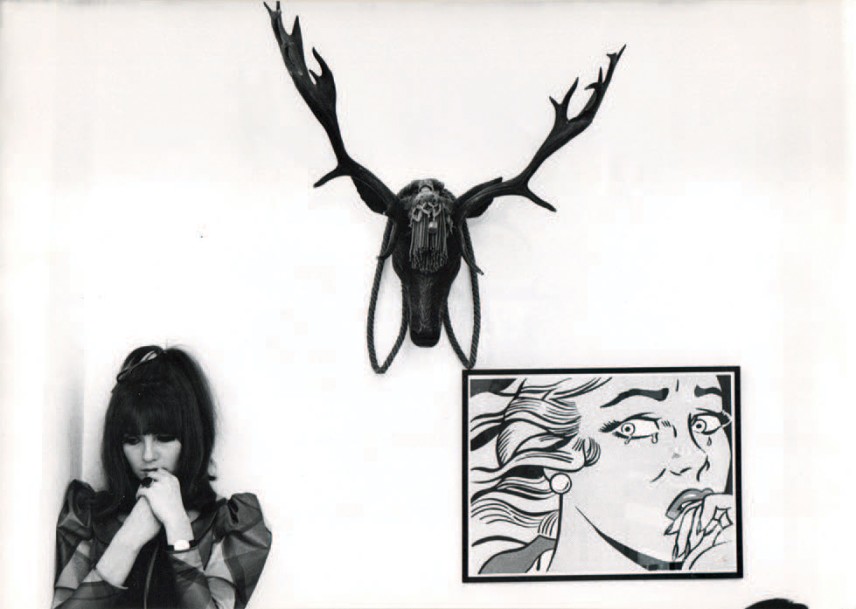
G.G. Passion (Eric Swayne) is one of the most successful pop and rock stars on the planet, and he cannot go out without being hounded by crowds of young women. He appreciates the fame they have given him, but he has his own coterie of models who live with him in his swanky, white-painted flat and they see to his every need as required, from dressing him in the morning to answering his telephone to keeping him company under the sheets. But what it this was all about to come crashing down?
David Bailey was not one of the cinema's most dedicated directors, only applying himself to the art very occasionally, and more deservedly known for his photography which had made his name in the nineteen-sixties. But back in 1966 he collaborated with two of the most talked about filmmakers of the era, Roman Polanski and writer Gérard Brach, so create his own twenty-five minute short as a commentary on the kind of fame Bailey himself was experiencing, if not on the same level of a Beatle or a Rolling Stone.
Passion here was supposed to be a surrogate for Mick Jagger who was riding high in the charts at the time with the Stones, and subject to an insane amount of scrutiny by those who were fans and those who certainly were not, alike. Though the opening his this was reminiscent of A Hard Day’s Night with its gaggle of girls chasing after the title character down a typical British street, it went off on a tangent fairly quickly as after establishing the home life of the rock star who had everything, we cut to a stereotypical businessman.
He was followed across the streets and down into subterranean corridors to meet with a board of other businesspeople in a cramped cellar where they decide rather abruptly to condemn G.G. to death. It's as if the authorities have been so incensed at this affront to their control that they are driven to wipe it out, though they are good enough to phone up our hero and inform him he has twenty-four hours to live. He spends those hours trying to get away, always returning to the same place where it is clear he can never escape no matter how far he runs (Swayne was a photographer himself in his day job - not an athlete).
On the plus side, he does fit in a visit to the zoo, always a good choice for a low budget production looking for a striking image (and giraffes will always grant you a looming closeup as they examine your camera), but on the negative, all his models jump out of the window, including Chrissie Shrimpton (then girlfriend of Jagger, so you had to wonder if he had any input here) and Caroline Munro (with her name spelt wrong in the credits), soon to be one of the faces of glamour in the following decade. Although this was a wacky, Richard Lester-esque jaunt for the most part, when Bailey opted to switch from black and white to colour, it was for a savage burst of blood red and a pretentious classical reference at the end, a commentary on pop culture's martyrs. Pleasingly, identifiably sixties for the most part, and considering Bailey was an inspiration for Michelangelo Antonioni's Blowup, had interesting credits (like sexploitation expert Stanley A. Long on board as cinematographer).
[This is included on the Stranger in the House Blu-ray in HD. Those other features on the disc:
Presented in High Definition and Standard Definition
Good Strong Coffee (c1968, 2 mins): swingers swig coffee in this psychedelic ad for the black stuff
Tram Journey Through Southampton (c1990, 1 min)
Charlie Chaplin Sails From Southampton (1921, 1 min)
Southampton Docks (1964, 24 mins): marvellous mod machinery at work on a merchant vessel
Original theatrical trailer
James Mason in Conversation (1981, 86 mins, audio only): the actor discusses his career in an interview at the National Film Theatre, London
Newly recorded commentary by Flipside founders Vic Pratt and William Fowler
Illustrated booklet with new writing by Jonathan Rigby, Omer Ali and Antion Vikram Singh Meredith (formerly Vic Briggs of The Animals).]