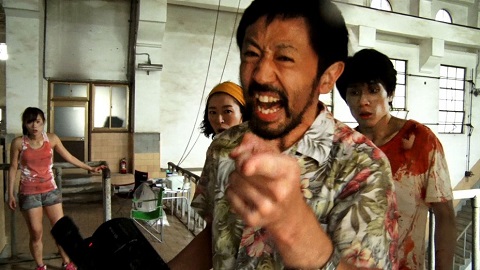
For Chinatsu (Yuzuki Akiyama), the worst has happened: her boyfriend Ko (Kazuaki Nagaya) has been turned into a zombie. As she wields an axe, he slowly advances on her, deaf to her protests until she calls out "Stop!" and he does. But when she starts speaking again, so he resumes his approach, and as she cannot bring herself to hit him with the blade, he sinks his teeth into her neck and - cut! It was all a movie, but the cameraman keeps shooting as the director (Takayuki Hamatsu) walks up to her, berating her in increasingly hysterical tones for ruining yet another take with her wooden acting, to the point that she breaks down in tears. Yet soon they will all have something to cry about...
With the zombie movie market saturated by the point One Cut of the Dead started to gain traction at festivals, you would have thought the genre had nothing more to be said, no more variations left, and no matter how many of them continued to be produced, they were doomed to repeat the same tropes over and over, seemingly immune to any sense of audiences really needing something different from their horror. However, just as the undead can rise again and again, apparently unstoppable and unkillable, zombie flicks stumbled on, and you were not sure whether to thank director Shin'ichirô Ueda for finding something genuinely original to perform within the parameters.
You could either thank him or curse him for being part of the reason The Walking Dead dragged on across the world's television screens, or whatever other slavishly devoted example popped up on a variety of budgets or languages on your nearest streaming service. But this was not your average George A. Romero rip-off (if you can even still call the type rip-offs at this stage), for while it seemed to be resting on a gimmick that the first thirty-seven minutes were played out in real time, hence "one cut" (rather than a wound to the skin, for instance), once it moved past that you could see it was less a shocker than it was a comedy, though it took a stretch of this for the penny to drop.
All the bits from that opening, continuous act which came across as amateur had a reason to be you might not have expected if you were coming to this unaware of what actually was going on and would be explained as it progressed. You may have thought, who are these jokers if they thought performances like that would pass muster in a professionally produced and released horror movie? Even for a comedy, there were bits where the camera plainly did not know where to be pointed at, acting that was so loose to the point of making those thespians looks as if they had not showed up to enough rehearsals, and effects that were often practically non-existent, so you could laugh at these results if you so chose, but more often you would be tempted to roll your eyes and think as a chiller, it made a fine technical exercise.
In fact, technically, for such a low budget work, it was impeccable: you simply didn't appreciate it until you saw the final act, which effectively returned to the first from a different angle. By doing so, you twigged that those performances best described as cheerfully shoddy and worst described as confused were entirely deliberate, and this cast, made up mostly of debuts, were putting in surprisingly terrific readings. As everything was explained, you would be grateful for not knowing too much about this going in - and if you were aware of the twists, you may regret having found out about them beforehand. Suffice to say, as the credits said, this was based on a play which one could only imagine was a Japanese, horror-themed take on the popular farce Noises Off, a favourite of provincial and community theatre around the globe, from which Ueda was evidently much influenced by, if merely by osmosis. It may not have been a traditional zombie film but was so much the better for it. Music by Kyle Nagai.