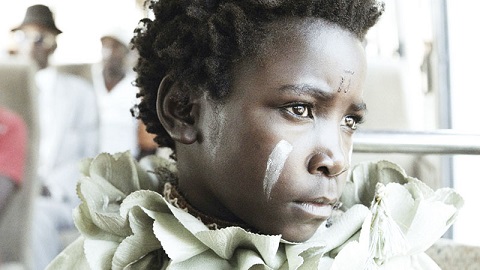
It could have happened to any woman or little girl in Zambia, but it happened to her. She was walking along the road leading to the watering hole her village used, and noticed a woman walking towards her with her bucket balanced on her head. The woman tripped and stared at the girl as if it was her fault, and the thought immediately took root in her mind: the girl (Maggie Mulubwa) had deliberately tripped her, cursed the well and the whole village because she was a witch. It didn't matter that there was no proof of his whatsoever, her fellow villagers loved the idea and soon had arranged a trial for her. She was dumbfounded by the allegation and had no idea how to react...
I Am Not a Witch was effectively the debut feature for director Rungano Nyoni after an apprenticeship of sorts making short films in some capacity or another, but this was the work that truly announced her as a talent to watch. Though born in Zambia, she was brought up in Wales, and started her career in Britain, but wanted to return to her homeland to make this story, an appeal to the wider world to be aware of the injustices happening to certain women there. Be accused of witchcraft and there is no going back, it would appear: you are henceforth damned to a life of slavery and banishment, with no hope of ever attaining anything like a normal life again.
This is what happens to the girl, who is called Shula by the women in the internment camp for witches for she is reluctant to reveal her real name, indeed she hardly speaks at all, as if shellshocked by her predicament. As she is something of a novelty, being a nine-year-old "witch", the local politician, Mr Banda (Henry B.J. Phiri) decides to exploit her in ways that her new allies are not so much, more or less making her his pet project to make money out of, starting with coaxing her into pronouncing one man out of a lineup guilty of theft. Needless to say, she has no idea of what she's doing, she simply chose at random, but this is enough evidence of special powers.
Nobody in this film has special powers, it should be noted, Nyoni kept the tone utterly non-supernatural and prosaic throughout to contrast with the ludicrous claims the superstitious Zambians make about the "witches". We quickly surmise these women are there to be scapegoats, thus eliminating the need to tackle the actual problems in these communities as everything that goes wrong is blamed on these innocents, who are forced to play along, be a tourist attraction (!), and take part in slave labour that nobody else wants to do. If they can pretend to make the rain fall during a drought with their "magic", so much the better - not for them, for the men making profits out of them, and the Queen too, who knows a nice little earner when she sees one, so all forms of authority are in on this.
Shula is the poor soul caught in the middle, tied to a long ribbon wrapped around a large bobbin at all times, as every witch is to prevent them running away, not so much a symbol of their enslavement as it is an actual device for exactly that. But not every Zambian is fooled: when Mr Banda takes Shula on a television chat show, the first caller asks how he expects the viewers to believe this bullshit when all Mr Banda is doing is sheer exploitation and raising his standing in the society by inventing a narrative where he is the do-gooder, when in fact the opposite is true. Sadly, we don't see enough of the wiser heads prevailing as there is too much at stake to admit the witchcraft is all made up to keep certain people in their place and provide a whipping boy (or girl) for a very suspicious community. When Shula is made to call up rain during a drought herself, and she cannot, thanks to her having no magic powers whatsoever, there's a tragic ending that pulls you up short after the deadpan, absurdist humour of what has gone before. Music by Matthew James Kelly.